Showing posts with label Muslims. Show all posts

Monday, April 05, 2021

NEWSHOUR CANVAS - At the Movies "The Mauritanian"

"‘The Mauritanian’ explores torture, abuse of former prisoner at Guantanamo BayPBS NewsHour 3/30/2021

Excerpt

SUMMARY:  The military prison at Guantanamo Bay, Cuba, took its first 20 detainees in 2002.  Despite various calls to shutter it, it still stands almost twenty years later.  A new movie now tells the story of Mohamedou Slahi, who spent 14 years within its walls, suffering abuse, even though he was never charged.  Amna Nawaz takes a look at "The Mauritanian" for our arts and culture series, CANVAS.


Monday, March 18, 2019

NEW ZEALAND - The Terror Attack

"New Zealand mosque suspect embraced white supremacy, previous acts of hate" PBS NewsHour 3/15/2019

Shooter's manifesto said Trump "Symbol of renewed white identity."  Just think about that and Trump's lack of total condemnation of white supremacy.

Excerpt

SUMMARY:  Christchurch, New Zealand’s second-largest city, was the site of horrific carnage Friday, as a gunman stormed two mosques during Friday prayers, killing at least 49 people and injuring dozens more.  Police arrested the alleged shooter, who cited other mass killings as inspiration.  Amna Nawaz reports on what New Zealand Prime Minister Jacinda Ardern called one of the country’s “darkest days.”


"Why alleged New Zealand mosque killer represents a broader ‘social movement’" PBS NewsHour 3/15/2019

Excerpt

SUMMARY:  Deadly terror attacks in New Zealand Friday caused global shock, but the extreme anti-immigrant, white supremacist ideology of the suspected Australian gunman is not new.  Judy Woodruff talks to Humera Khan of Muflehun a nonprofit fighting hate and extremism, University of Chicago’s Kathleen Belew, and Matthew Knott of the Sydney Morning Herald about the scope of this malignant "social movement."


REMINDER:  The internet, especially social media, allows the spreading of ideas good AND bad.

"The role of media and technology after terror attacks" PBS NewsHour 3/16/2019

Excerpt

SUMMARY:  The gunman accused of killing 49 people at two New Zealand mosques Friday live-streamed the attack, emailed his manifesto to media outlets, and shared his racist and hateful messages online.  Charlie Warzel opinion writer-at-large for The New York Times and Joan Donovan of Harvard University, join Hari Sreenivasan to discuss changing technology and the media's role and responsibilities.

Monday, March 19, 2018

THE LEGACY - Holocaust Education of New People

"To douse growing anti-Semitism, Germans call for Holocaust education for recent migrants" PBS NewsHour 3/14/2018

Excerpt

SUMMARY:  With more than a million newcomers to Germany since 2015, there's been a resulting rise in anti-Semitism.  Now there are growing calls to mandate that refugees and Muslim migrants visit concentration camps to help improve their understanding of the country's terrible past and the echoes today.  Special correspondent Malcolm Brabant reports.

Monday, December 18, 2017

WAR ON ISIS - Adapting to Inspire

aka The ISIS Army is loosing but the ideological war continues.

"Attempted pipe-bomb attack sparks panic in New York subway" PBS NewsHour 12/11/2017

Excerpt

SUMMARY:  Emergency crews swarmed the streets near Times Square this morning after a man detonated a homemade pipe bomb in the New York subway, creating a panic during rush hour.  The suspected attacker, identified as 27-year-old Akayed Ullah, was taken to the hospital with minor burns.  Officials believe he was inspired by the Islamic State group.  William Brangham reports.


"Counterterrorism chief says ISIS adapting to inspire, not control attacks" PBS NewsHour 12/11/2017

Excerpt

SUMMARY:  What do officials know about the attempted morning attack of a New York subway and the motives of the alleged bomber?  Nicholas Rasmussen, outgoing director of the National Counterterrorism Center, joins Judy Woodruff to discuss the difficulties of preventing such attacks and the chances of another 9/11-style event.

Monday, November 27, 2017

EGYPT - ISIS Attack on Muslims

A reminder that ISIS is not just an enemy of the West, but an enemy of the world.

"Militants target Muslims in Egypt’s deadliest modern attack" PBS NewsHour 11/24/2017

Excerpt

SUMMARY:  Attackers unleashed mayhem and carnage on a crowded mosque in Egypt's Sinai Peninsula on Friday.  At least 235 people were killed by militants who detonated explosives and shot worshippers as they tried to escape.  Judy Woodruff learns more from Declan Walsh of The New York Times.

Monday, July 31, 2017

MUSLIMS - Persecution Elsewhere

"Myanmar's Rohingya stuck in limbo between persecution and relocation" PBS NewsHour 7/24/2017

Excerpt

SUMMARY:  The Rohingya people, an ethnic Muslim minority group, have fled murder and persecution by the army of Myanmar to seek refuge in camps in
Southern Bangladesh, but their arrival has been less than welcome.  Special correspondent Tania Rashid reports.

Monday, July 10, 2017

NEWSHOUR SHARES - CoverGirl's Nura Afia

"How a Muslim-American glamour girl became the new face of CoverGirl" PBS NewsHour 7/5/2017

Excerpt

SUMMARY:  In our NewsHour Shares moment of the day, Nura Afia went from watching YouTube videos as a young mother, to becoming a fashion video blogger with an international following, to being named CoverGirl's first Muslim brand ambassador.

Monday, May 15, 2017

TRUMP AGENDA - Travel Ban vs Appeals Courts

"Explaining Trump's travel ban appeals court arguments" PBS NewsHour 5/8/2017

Excerpt

SUMMARY:  President Trump's travel ban got its first federal appeals court review today, marking the biggest test yet for the revised executive order to suspend travel to the U.S. for people from six majority-Muslim countries.  Marcia Coyle of The National Law Journal joins William Brangham to review the arguments.

Tuesday, March 07, 2017

MUSLIMS - The Reality of Threat to America

Just after the 9/11 Attack I started to look at Islam under the rubric of 'know thy enemy' (my military training).

In the Alternate-Universe of Trump Land and his supporters, there has been total distortion of the threat Muslims pose to America.

I have read up on Islam (the religion) and Muslims (those who practice Islam) and I know that the vast majority are NO THREAT to America.  Islam is a peaceful religion, at least as peaceful as any religion including Christianity.

"Islam is a verbal noun originating from the triliteral root s-l-m which forms a large class of words mostly relating to concepts of wholeness, submission, safeness and peace."

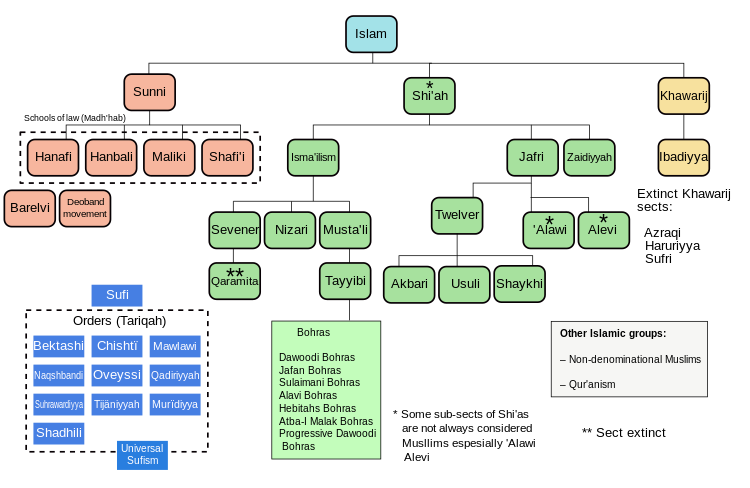
Denominations


  • Sunni

The largest denomination in Islam is Sunni Islam, which makes up 75%–90% of all Muslims and is arguably the world's largest religious denomination.  Sunni Muslims also go by the name Ahl as-Sunnah which means "people of the tradition [of Muhammad]."  These hadiths, recounting Muhammad's words, actions, and personal characteristics, are preserved in traditions known as Al-Kutub Al-Sittah (six major books).

  • Shia

The Shia constitute 10–20% of Islam and are its second-largest branch.

While the Sunnis believe that a Caliph should be elected by the community, Shia's believe that Muhammad appointed his son-in-law, Ali ibn Abi Talib, as his successor and only certain descendants of Ali could be Imams.  As a result, they believe that Ali ibn Abi Talib was the first Imam (leader), rejecting the legitimacy of the previous Muslim caliphs Abu Bakr, Uthman ibn al-Affan and Umar ibn al-Khattab.  Another point of contention is the cursing of figures revered by Sunnis.  However, Jafar al-Sadiq himself disapproved of people who disapproved of his great grand father Abu Bakr and Zayd ibn Ali revered Abu Bakr and Umar.  More recently, Grand Ayatollah Ali al-Sistani condemned the practice

  • Sufism

Sufism, or tasawwuf (Arabic: ??????), is a mystical-ascetic approach to Islam that seeks to find a direct personal experience of God.  It is not a sect of Islam and its adherents belong to the various Muslim denominations.  Classical Sufi scholars have focused on the reparation of the heart and turning it away from all else but God by making use of "intuitive and emotional faculties" that one must be trained to use.  Hasan al-Basri was inspired by the ideas of piety and condemnation of worldliness preached by Muhammad and these ideas were later further developed by Al-Ghazali.  Traditional Sufis, such as Bayazid Bastami, Jalaluddin Rumi, Haji Bektash Veli, Junaid Baghdadi, and Al-Ghazali, argued for Sufism being based upon the tenets of Islam and the teachings of Muhammad.

ISIS (aka ISIL)

The Islamic State of Iraq and the Levant (ISIL, IPA /?a?s?l/), also known as the Islamic State of Iraq and Syria (ISIS, /?a?s?s/), Islamic State (IS), and by its Arabic language acronym Daesh (Arabic: ?????? d??ish, IPA: [?da????]), is a Salafi jihadist unrecognized proto-state and militant group that follows a fundamentalist, Wahhabi doctrine of Sunni Islam.

ISIL is a theocracy, proto-state and a Salafi or Wahhabi group.  It follows an extremist interpretation of Islam, promotes religious violence, and regards Muslims who do not agree with its interpretations as infidels or apostates.

The 'West' also are seen as infidels by ISIS.  And there (false) interpretation of Islam says they have an obligation to kill those who they see as infidels.

Now - Why Muslims are not a threat to America:
  • There are approximately 1,600,000,000.00 Muslims world wide.
  • There are approximately 100,550.00 ISIS and supporters world wide.
Do the math.  This means 0.0063% of Muslims, world wide, follow or believe ISIS.

Note the above numbers are the latest I could find from several sites via Google.
------
So, should Americans be cowering in fear of ANY Muslim they encounter?  I say NO!

We should welcome and support Muslims in general.  And support Muslim organizations fighting against ISIS.  Example: True Islam

The truth, there will be no defeat of ISIS world wide because it is a religious-based group, we can only defeat the ISIS army, which is underway now.  The ONLY true defeat of ISIS will be by other Muslims defeating their doctrine.


Monday, December 26, 2016

GERMANY - Berlin Truck Attack

"Is Berlin truck attack a turning point for Germany?" PBS NewsHour 12/20/2016

Excerpt

SUMMARY:  Berlin's normally bustling Christmas market was quiet Tuesday, as investigators searched for clues into a truck attack that killed a dozen people and injured 50.  A suspect who was detained after the attack was released due to insufficient evidence, and the Islamic State later claimed responsibility.  From Berlin, special correspondent Malcolm Brabant reports.

JUDY WOODRUFF (NewsHour):  The Islamic State group has claimed responsibility tonight for the Berlin truck attack that killed a dozen people and injured 50.

That word came hours after German police let their main suspect go.

Special correspondent Malcolm Brabant reports from Berlin.

MALCOLM BRABANT, Special correspondent:  This normally bustling Christmas market was eerily quiet today, as investigators searched for clues.

Swathed in fog, and with armed guards sealing off the area, Berlin was coming to terms with its new status as a victim of terrorism, after Paris, Brussels, and Nice.

German Chancellor Angela Merkel spoke at a morning news conference.

ANGELA MERKEL, Chancellor, Germany (through translator):  There is still a lot that we don't know about this act with sufficient certainty, but we must, as things stand, assume it was a terrorist attack.

MALCOLM BRABANT:  Police detained a Pakistani asylum-seeker shortly after the truck rammed into a crowd of people on Monday.  But, today, he was released, due to insufficient evidence.  Prosecutors said he matched a description of the suspected attacker, but he denied any involvement.

The truck, which had been carrying steel beams, was towed away earlier this morning.  The body of a Polish truck driver was found inside the cabin.  He had been stabbed and shot after being hijacked.  The gun used to kill him has yet to be found.

PROF.  PETER NEUMANN, King's College, London:  It was waiting to happen, no?  I'm not, like, totally surprised.

MALCOLM BRABANT:  Berlin is the hometown of terrorism expert Peter Neumann.  He believes German authorities were too complacent about the possibility of an attack and didn't offer sufficient protection to the Christmas markets.

PROF.  PETER NEUMANN:  I think, in Germany, people have been very blessed with the idea that they would be spared this kind of attack.  And so I don't think that German authorities were thinking as systematically about the threat from terrorism as authorities in Britain have or authorities in other countries.

This will have to change.  And there will be a very uncomfortable discussion in Germany about anti-terrorism measures, but also, of course, about the relationship with Muslim communities and with refugees.


"Berlin attack suspect is a ‘nightmare' for authorities" PBS NewsHour 12/21/2016

Excerpt

SUMMARY:  The manhunt stemming from Monday's Christmas market massacre in Berlin has spread across Europe, and there's a new suspect.  His name is Anis Amri, and he is a 24-year-old asylum seeker from Tunisia.  Judy Woodruff speaks with special correspondent Malcolm Brabant, who is in Berlin, about the suspect's criminal history, the reward for information about him and increased surveillance in Germany.


"Why German surveillance failed to stop the Berlin attack suspect" PBS NewsHour 12/22/2016

Excerpt

SUMMARY:  The man suspected of carrying out an attack on a Christmas market was well known to German authorities.  Anis Amri was under surveillance for six months and slated for deportation, but his home country refused to accept him.  Hari Sreenivasan speaks with Peter Neumann of King's College about how German authorities could have missed the signals.

Monday, December 12, 2016

ART - Of the Quran

Remember, NOT all Muslims are like ISIS.  In fact the majority think ISIS is a corruption of Islam.

"Exhibit illuminates the divine art of the Quran" PBS NewsHour 12/7/2016

Excerpt

SUMMARY:  A major exhibition on the art of the Quran is being billed as the first of its kind in the U.S.  Sixty-eight of the most important and exquisite Qurans ever produced are on view now at the Smithsonian's Sackler Gallery in Washington, D.C.  Jeffrey Brown reports on the vast variety of manuscripts on display and the beauty, history and hard work behind each masterpiece.

JUDY WOODRUFF (NewsHour):  In the charged atmosphere at this time around the role of Muslims in America comes what is billed as the first major exhibition on in the United States on the Quran.

Jeffrey Brown reports.

MASSUMEH FARHAD, Arthur M.  Sackler Gallery, Smithsonian Institution:  This is one of the great highlights of the exhibition.  It's a Quran from the early 14th century, from about 1330, signed by a great master.

JEFFREY BROWN (NewsHour):  Signed?

MASSUMEH FARHAD:  Signed.

JEFFREY BROWN:  Yes.

A holy book, as a work of art, the Quran, sacred to some 1.6 billion Muslims around the world.  A new exhibition at the Smithsonian Institution's Sackler Gallery in Washington, D.C., presents 68 of the most important and exquisite Qurans ever produced.

Dating from the late 7th to early 17 centuries, they come from many parts of the Islamic world and are part of the collection of the Museum of Turkish and Islamic Arts in Istanbul.  That's where Sackler chief curator Massumeh Farhad first saw them.

MASSUMEH FARHAD:  I realized that these were true works of art, that every single one of them was astounding in its sort of mastery of calligraphy, of the styles, and also of the scale of the works.

And that is something that, to me, was very important, and motivated me in trying to organize this exhibition, because I thought it really shifted my perception of what these works are.  And I'm hoping that it will also shift the perception of the visitors who come to the museum to see the exhibition.

Monday, August 08, 2016

TRUMP NOT FILES - Criticism of Americans

"Will Trump's criticism of regular Americans hurt him with voters?" PBS NewsHour 8/1/2016

Excerpt

SUMMARY:  How will Donald Trump's recent criticism of Khizr and Ghazala Khan's speech and his comments on Russia and Ukraine affect his campaign?  And as both candidates go after Rust Belt voters, whose strategy will prevail?  Gwen Ifill talks with Tamara Keith of NPR and Amy Walter of The Cook Political Report.

GWEN IFILL (NewsHour):  For more on the fight between Donald Trump and the Khan family, his recent comments on Russia's intervention in Ukraine, and Hillary Clinton's weekend outreach to Rust Belt voters, it's time for Politics Monday with Tamara Keith of NPR and Amy Walter of The Cook Political Report.

You just heard Ghazala Khan say to Judy in response to the questions about Donald Trump's feud, whatever it is, that, “I can take it.”

We have heard in the last few moments Warren Buffett on behalf of Hillary Clinton say, have you no decency, sir?  You have made no sacrifice.

We heard John McCain also scold, but not withdraw his endorsement today of Donald Trump.

I wonder, starting with you, Amy, whether it's ever a good thing to have to defend yourself by tweet?

AMY WALTER, The Cook Political Report:  No, but at the same time, nothing about this campaign has seemed normal.  Right?

The traditional candidate response to a speech like Mr. Khan gave would be to say, my condolences for your loss.  Here is my differences of opinion on the policy of it, right?  I differed with Hillary Clinton and the Obama administration on the war on terror.  I differed with President Bush on going to Iraq in the very first place, even though he did say he supported it early on, when he invaded Iraq.

But that is the answer that a traditional politician would give.  And, Gwen, I just feel I should just come out here with a tape recorder and just every week say, nothing that he does is like a traditional politician would ever do.

What we are seeing is, his supporters, I think, will continue to rally around him, but every day that this campaign is about Donald Trump and his messaging, which is not — which is about him and not about the bigger, broader issues, I don't think that's a good day for Donald Trump.

GWEN IFILL:  Let's flip the script a little bit.

Hillary Clinton, it seems to me, was asked about Pat Smith, the Benghazi mom, who spoke at the Republican Convention, and what was her reaction?

TAMARA KEITH, NPR:  Her reaction was more the typical politician answer.  It was, thank you for your family's service.  I can't begin to understand your loss, that kind of thing.

And then she did get to the question of whether she remembered it the same way.  But she remained respectful throughout, and you wouldn't call it a feud.

That's the difference is, in the way Hillary Clinton answered, it ended there.  And look at George W.  Bush.  Cindy Sheehan was parked outside his ranch for a very long time protesting him, and George W.  Bush…

GWEN IFILL:  In 2008.

TAMARA KEITH:  Was it — it was earlier.  I think it was even maybe 2004.

GWEN IFILL:  Yes.

AMY WALTER:  Right.  Right.

TAMARA KEITH:  And George W. Bush said, that is her right, that is her right to protest, that is her right to say anything she wants about me, because this is America, actually.


"Khizr Khan: As candidate for the highest office, Trump needs tolerance for criticism" PBS NewsHour 8/1/2016

Excerpt

SUMMARY:  Khizr and Ghazala Khan, a Muslim-American couple whose 27-year-old son died as a soldier during the Iraq War, stood before the Democratic National Convention last week to share their loss and criticize Donald Trump.  Lisa Desjardins recaps the political feud that ensued, then the Khans sit down with Judy Woodruff to discuss Trump's comments about Muslims, terrorism and immigration.

Monday, June 20, 2016

FROM A MUSLIM - Heartfelt Words on Orlando

"An Orlando Muslim’s heartfelt words on nightclub mass shooting" PBS NewsHour 6/15/2016

Excerpt

SUMMARY:  Rubana Khan of Orlando, in heartfelt verse, sends apologies from her Islamic family to the families of the victims of Sunday’s mass shooting.  In doing so, she lays bare the pain the killer, Omar Mateen, has caused her and other Muslims, who consider their religion one of peace, not of violence or hatred.

Monday, May 23, 2016

HARASSMENT - Combating Islamophobia

"Teaching ‘different is OK' to combat Islamophobia in U.S. schools" PBS NewsHour 5/17/2016

Excerpt

SUMMARY:  According to a new study, some 50 percent of all Muslim students in the U.S. have been bullied by their peers.  In mostly-white St. Cloud, Minnesota — where thousands of east African refugees have relocated — the problem got so bad that Muslim students walked out of the city's high school en massè.  John Tulenko of Education Week takes a look at the intersection of education and Islamophobia.

JOHN TULENKO, Education Week:  Hafsa Abdi, who's 18-years-old, remembers well the day four years ago when she was first bullied for being Muslim.

HAFSA ABDI, Student, St. Cloud Technical High School:  The last day of by eighth grade year, I was just going home, and then this boy — I think he was a year younger than me — he pulled off my hijab.  And at the time, I was wearing a longer one, so it was more easy to kind of like pull off from the back.

And then I also had like a pin underneath to hold it in place.  And then that kind of came loose.  So, like, at the time I was just trying to think of like five different things at one time, like trying to get the pin to not stab me in the neck, and then turn around to see who this kid is.

JOHN TULENKO:  In high school, the bullying continued, especially when she and other Muslim students would gather to pray.

HAFSA ABDI:  Mostly, the upperclassmen, they would come into the bathroom sometimes and start fighting with the Somali girls that were trying to wash for prayer, and then when it gets reported, nothing would happen.

JOHN TULENKO:  What would they say?

HAFSA ABDI:  So they'd be like, oh, well, why are you making the bathroom dirty, you stinky Somalian or you terrorist or stuff like that, or go back to where you came from.

JOHN TULENKO:  Where Hafsa comes from is Minnesota.  She was born here, after her parents fled Somalia to escape civil war.  Thousands of other East African refugees have also come to St. Cloud, changing the face of this mostly white, mostly Catholic small city.

WILLIE JETT, Superintendent, St. Cloud Area School District 742:  My job is to make sure that all children, whether it's their children, whether it's somebody brand-new to the country, that they have the best tools available to be successful here in America, here within our community.

JOHN TULENKO:  For superintendent Willie Jett, educating the new arrivals required changes across the board.

WILLIE JETT:  What we have had to do is start from ground zero.  You're trying to make sure that, (A) All the different languages within school are welcomed.

You're trying to make sure that you have interpreters.  You're making sure that you're revamping teaching staff and support staff and the way that you hold conferences, the way that you send messages home.  It's not what it was 20, 30, 40 years ago, even 10 years ago.

BOSNIA - The Sarajevo Mosque

"Is Saudi-funded mosque in Sarajevo threat to Bosnia's moderate Muslims?" PBS NewsHour 5/16/2016

Excerpt

SUMMARY:  International officials are convinced that Bosnia's brand of Westernized, moderate Islam is the best possible bulwark against radicalization.  The nation's official Islamic Community is cracking down on rural mosques that it says are too in line with Islamists — but some say the true extremist threat lies in the heart of the capital itself.  Special correspondent Malcolm Brabant reports.

MALCOLM BRABANT (NewsHour):  I'm in Central Bosnia, about 100 miles from the capital, Sarajevo.

I'm heading up to a remote mountain village called Osve, which is a place where, supposedly, there are some supporters of the so-called Islamic State.  There have been people who've gone from this village to fight in Syria.  Some have reportedly been killed.  And we're going to meet somebody who used to play rock ‘n' roll, but is now labeled by the head of the Islamic community in Bosnia as someone who is a terrorist.

Izet Hadzic used to be lead guitarist in a band called Black Lady.  After fighting in the Bosnian War, he abandoned what he thought was a decadent lifestyle and sought peace in religion.  He leads one of these so-called radical mosques.  While he's in dispute with the Islamic establishment, he insists he's no terrorist.

IZET HADZIC, Mosque Leader (through interpreter):  Where does it come from to call us terrorists?  It is because that people who look like us, have these beards, are doing such acts in the world, specifically ISIS and this cretin Baghdadi.

MALCOLM BRABANT:  Two doors away from Hadzic's small holding is the father of a young man killed in Syria.  Next door is a family Hadzic regards as extreme.  Bosnian intelligence officers are frequent visitors.

Hadzic unequivocally condemns Islamic State.

IZET HADZIC (through interpreter):  You can't call this jihad.  To take a gun while someone is walking down the street with his family and begin to shoot?  Can you imagine soldier doing this?  These people are equal to cowards.

MALCOLM BRABANT:  We had a polite, but frosty reception in Bocinje, a nearby village that was a stronghold of foreign mujahideen during the Bosnian War.  We hoped to interview a man who returned from Syria in 2014, but he didn't want to be filmed because of an impending court case.  His name is Ibrahim Delic.

Dozens of other Bosnians now in Syria are said to want to return because they are horrified by ISIS atrocities.  Crippled and radicalized during the Bosnian War, Delic recently talked to the Balkan Investigative Reporting Network.  Significantly, he criticized the Free Syrian Army, who are enemies of ISIS.

Monday, January 25, 2016

NEWSHOUR ESSAY - A Muslim Jedi

"Why the world could use a Muslim Jedi" PBS NewsHour 1/22/2016

Excerpt

SUMMARY:  How can we relieve anti-Muslim discrimination?  Haroon Moghul says that adding a Muslim character to a certain science fiction franchise (Star Wars) might go a long way in changing perceptions (Islamophobia) and offering a vision of a more united future.

Monday, January 04, 2016

AMERICAN MUSLIM - Ask A Muslim

"Muslim woman sets up 'Ask A Muslim' stand in Massachusetts & what happens may surprise you" by Leslie Salzillo, Daily Kos 12/28/2015

In a beautiful act of courage and hope, Mona Haydar, a Muslim, set up an “Ask a Muslim” stand in Cambridge, Massachusetts, hoping to bring more understanding of the Muslim community.  She also offered people who passed by the stand in front of a local library a free cup of coffee and doughnut to further beckon a Q&A chat.

The idea came to Haydar during dinner with her husband.  In efforts to create positive change, they decided to do something “kind of crazy.”

"He had seen this segment on This American Life, where a young Iraqi man had done 'Ask an Iraqi,' " Haydar tells NPR's Carrie Kahn.  "And so [Sebastian] was like, 'Why haven't we thought of this before?  Why don't we get out and talk to people?'

"So, we did it," Haydar says.

NPR staff reports:

After the day was done, she posted a summary to Facebook — a post which has now garnered more than 11,000 likes and the attention of several different media organizations.

"We weren't out there that long today but the take away was clear: Keep your heads held high, dear Muslim family," she wrote in that post.  "There is an overwhelming amount of love and so remember this post when you are faced with bigotry and hatred towards you or your faith.

Mona Haydar says she initially thought the experience would be negative.  As it turns out, the experience and interaction with many folks was very positive—so much, in fact, that she and her husband look forward to doing it again soon.  Haydar mentioned that rather than asking questions, most people approached her to say they liked what she was doing.  Some passersby even felt compelled to apologize for the worldwide discrimination against Muslims.  Pretty cool.

You can read more of the Carrie Kahn/NPR interview with Mona Haydar via NPR.orgThere is so much good in this world, and many of us want to believe that the good ultimately, and always, out-trumps the bad.  (And yes, that pun was intended—for goodness sake.)

Thank you Mona Haydar and Sebastian Robins.  You can visit Mona Haydar on her Facebook Page.

Monday, December 14, 2015

OPINION - Shields and Brooks 12/11/2015

"Shields and Brooks on the GOP’s Trump problem, Paul Ryan’s speaker leadership" PBS NewsHour 12/11/2015

Excerpt

SUMMARY:  Syndicated columnist Mark Shields and New York Times columnist David Brooks join Judy Woodruff to discuss Republican presidential candidate Donald Trump's comments on banning Muslims from entering the U.S., a campaign surge for Sen. Ted Cruz, plus assessing Speaker of the House Paul Ryan’s first month on the job.

Monday, May 18, 2015

BOSTON BOMBING - Reaction to Death Sentence

"Boston bombing victims react to Tsarnaev death sentence" PBS NewsHour 5/15/2015

Excerpt

SUMMARY:  Dzhokhar Tsarnaev has been sentenced to death for the 2013 Boston Marathon bombings that killed three.  The federal jury chose to sentence the 21-year-old to death by lethal injection over life in prison without possibility of release.  Judy Woodruff talks to Emily Rooney of WGBH to learn more about the reactions from victims and their families.

JUDY WOODRUFF (NewsHour):  The Boston Marathon bomber was sentenced to death today; 21-year-old Dzhokhar Tsarnaev was convicted by a federal jury last month of the April 2013 bombings that killed three bystanders near the finish line of the annual race.

Tsarnaev and his older brother, Tamerlan, later killed a policemen during a manhunt.  The elder Tsarnaev died in a gun battle with police.  The jury chose death over the only other option, life in prison without possibility of release.

After the penalty was announced, the U.S. attorney who led the prosecution and a bombing victim spoke.

CARMEN ORTIZ, U.S. Attorney, District of Massachusetts:  Today, the jury has spoken, and Dzhokhar Tsarnaev will pay with his life for his crimes.  Make no mistake.  The defendant claimed to be acting on behalf of all Muslims.  This wasn’t a religious crime and it certainly doesn’t reflect true Muslim beliefs.  It was a political crime designed to intimidate and to coerce the United States.

KAREN BRASSARD, Boston Bombing Survivor:  Today feels different only because it’s — it is more complete, I guess, is how I’m going to say it.  I know that there is still a long road ahead.  There’s going to be many, many, many more dates ahead, but right now it feels like we can take a breath.

Friday, February 20, 2015

U.S. MUSLIMS - Take ISIS On


Humera Khan, the founder of Muflehun, a think tank that focuses on countering violent extremism, during a youth leadership and safety conference in Avon, Conn., in November.
Credit Katherine Taylor for The New York Times

"U.S. Muslims Take On ISIS’ Recruiting Machine" by LAURIE GOODSTEIN, New York Times 2/19/2015

Imam Mohamed Magid tries to stay in regular contact with the teenager who came to him a few months ago, at his family’s urging, to discuss how he was being wooed by online recruiters working for the Islamic State, the extremist group in Syria and Iraq.

But the imam, a scholar bursting with charm and authority, has struggled to compete.  Though he has successfully intervened in the cases of five other young men, persuading them to abandon plans to fight overseas, the Islamic State’s recruiting efforts have become even more disturbing, he said, and nonstop.

“The recruiters wouldn’t leave him alone,” Imam Magid said of the young man he met with recently.  “They were on social media with him at all hours, they tweet him at night, first thing in the morning.  If I talk to him for an hour, they undo him in two hours.”

President Obama on Wednesday described the fight against violent extremism as a “generational challenge” that would require the cooperation of governments, religious leaders, educators and law enforcement.  But even before he called on more than 60 nations to join the effort, the rise of the Islamic State and the attacks by homegrown terrorists in Paris, Ottawa, Copenhagen and Sydney, Australia, had jolted American Muslims into action.

Muslim leaders here and elsewhere have already started organizing or expanding prevention programs and discussions on countering violent extremism, often with assistance from law enforcement officials and trained counter-recruiters who emphasize that the Internet’s dangers for young Muslims now go far beyond pornography.

With the Islamic State in particular deploying savvy online appeals to adolescents alongside videos of horrific executions, the sense of urgency has grown.  Though some Muslim leaders still resist cooperating with the government, fearing that they would be contributing to religious profiling and anti-Muslim bigotry, many have been spurred to respond as they have come into contact with religiously ardent youths who feel alienated by life in the West and admit that they have been vulnerable to the Islamic State’s invitation to help build a puritanical utopia.

“The number is small, but one person who gets radicalized is one too many,” said Rizwan Jaka, a father of six and the board chairman of the All Dulles Area Muslim Society, where Imam Magid is the spiritual leader.  “It’s a balancing act:  We have to make sure our youth are not stereotyped in any way, but we’re still dealing with the real issue of insulating them from any potential threat of radicalization.”

In practice, it often means one-on-one conversations with Muslims like Amir, a 22-year-old computer programmer in Virginia who said he was drawn to extremist videos from the Islamic State, also known as ISIS or ISIL, because he was a new convert struggling with how to live out his faith in the United States.  He said he chafed at having to work in an office with Muslim women who covered their heads but wore clothing he considered too tight.  He also did not like seeing photographs of people on the walls, or advertisements for credit cards, which he said Islam strictly forbids.  “Every time I mentioned it, no one heard me out,” he said.  “I definitely felt like a stranger.”

He said his disenchantment with the Islamic State began when the group beheaded Peter Kassig, who reports said was a Muslim convert, and later executed a Jordanian pilot.  Amir then had some long talks with Imam Magid, who pointed him to passages in the Quran that forbid killing other Muslims, innocent women and children.  Amir concluded that the Islamic State was only sowing chaos and hatred, which the Prophet Muhammad abhorred.

“The Islamic State once looked like eye candy to me,” said Amir, who was willing to be identified only by his first name because he did not want to attract the attention of extremists.  “But now I think they are deviants.”

Imam Magid described Amir as “the kind of person who is vulnerable to ISIS” — an alienated young Muslim with a black-and-white worldview, looking for purpose and adventure.  But, he added, it is often hard to identify which people are most at risk.

Here in suburban Virginia — where Muslim parents tend to be professionals whose children are enmeshed in American culture and are more likely to spend time at the mall than watching extremist videos — the threat still feels remote, especially for those who are active in mosques.  Many homegrown extremists in the West were converts who had little exposure to the faith, or education in it.

Many parents and religious leaders are struggling with where to focus their efforts.  Imam Magid, who is in regular communication with the F.B.I. and other law enforcement agencies, said the young men he had counseled came from a variety of family backgrounds.

Humera Khan, the founder of Muflehun, a think tank based in Washington that focuses on countering violent extremism, said that increasingly, there is no consistent profile of those who are targeted for recruitment or drawn to Islamic extremists.

“There are no patterns, and that’s making it harder for everyone,” she said in an interview in Virginia late last month.  “They can come from every ethnic, socioeconomic group, any geographic area.  But they are more often men than women, and they’re getting younger.”

Officials estimate that about 150 Americans have traveled, or tried to travel, to fight in Syria.  That is fewer than in France, where 1,000 people are estimated to have gone to Syria, or England, which has counted about 600, not including those who were in touch with extremists online and decided not to join.

Imam Magid said that in addition to those he had talked out of going, he knew of one young Muslim from Virginia who recently left to join the Islamic State in Syria.  (He said he had never met this man or had a chance to dissuade him.)

In Chicago in October, two brothers, ages 19 and 16, and their 17-year-old sister were detained at the airport on their way to Turkey to join the Islamic State.  Three girls from Denver, one as young as 15, were stopped at an airport in Germany the same month on their way to join militants in Syria.  All were reportedly recruited over the Internet.  And that has provoked new levels of introspection, both private and public, among American Muslims of all ages.

At a forum for Muslim millennials in Washington sponsored by the Muslim Public Affairs Council last year, college students and Muslim leaders speculated about why a group as barbaric as the Islamic State had successfully attracted any Muslims at all from the West.

“ISIS says:  ‘Come here.  We’ve got ripped warriors,’ ” said Imam Suhaib Webb, a popular Muslim leader who moved from Boston to the Washington area last month.  “It’s a very simplistic response, but it’s somewhat effective.”

He said that in more than 15 years as an imam, he had encountered only five Muslims considering whether they should join violent militant groups, and that none of them had actually left the United States to fight.  “They were all males,” said Imam Webb, and “they all had daddy issues.”  He added, “They were not really drawn to this on theological grounds.”

Ms. Khan, who has four degrees from M.I.T., left lucrative consulting work to develop a prevention program that addresses extremism and the way that technology can be used for manipulation.  At one of her events last year, about 30 young Muslims, both high school and middle school students, gathered at the Farmington Valley American Muslim Center in Avon, Conn., for what was billed as a “cybersafety workshop,” with Ms. Khan moving swiftly from how to detect online pedophiles to how to detect Islamist extremists.

“They are telling you, ‘Let’s go fight.’  They are asking you to share gruesome images,” said Ms. Khan, who wore a blue floral-print head scarf.  “Be very careful.  These people are not your friends.”  She told the students, who were quick to raise their hands and ask questions, to avoid contact with strangers online, or with anyone who demanded secrecy.  The sexual predators are usually male, she told them, but the extremist recruiters can be male or female, and some of them can be, or can pretend to be, teenagers, too.  Her presentation included a picture of a wolf zipped into a sheep’s skin.

“Have you guys heard of grooming?” she asked them, using a term more often used in relation to sexual predators.  “They will try to be your friend.  They will be nice to you, spend lots of time with you.  Some of them will be sending you gifts.”

Programs like this have not been embraced as a widespread priority by American Muslims, at least until recently, in part because the problem seemed to be overseas, not here, Muslim leaders say.  And since many American Muslims are immigrants or African-Americans, there is substantial fear and suspicion of law enforcement officials, along with simple defensiveness and denial.

“The family says, ‘It’s not going to happen to me,’ ” said M. Saud Anwar, a pulmonologist and the first Muslim to be elected as a mayor in Connecticut, where he serves South Windsor.

Imam Magid, speaking upstairs at his Muslim center while a team of Muslim girls pounded out a basketball game below, said that real prevention meant programs that give young people as much purpose and inspiration as extremists promise.  Once young Muslims buy into the ideology, he said, it is very hard to pry them loose.  “You have to reach them before it happens,” he said.
