Showing posts with label Islam. Show all posts

Monday, May 06, 2019

RELIGION UNDER ATTACK - Religious Leaders' Response

"Amid rising attacks on places of worship, how religious leaders are responding" PBS NewsHour 4/30/2019

Excerpt

SUMMARY:  The deadly California synagogue shooting is the latest in a series of attacks that raise profound questions about keeping sacred spaces safe.  Judy Woodruff talks to the Islamic Center of Greater Cincinnati's Shakila Ahmad, Rabbi Devorah Marcus from Temple Emanu-El of San Diego, Ted Elmore of the Southern Baptists of Texas Convention, and Bishop Eugene Sutton of the Episcopal Diocese of Maryland.

Monday, January 08, 2018

IRAN - The Protests

"Iranian president calls for calm amid deadly protests" PBS NewsHour 1/1/2018

Excerpt

SUMMARY:  Iran saw a fifth day of anti-government protests on Monday with at least 12 fatalities reported.  Iranian President Hassan Rouhani called for calm amid the regime’s most serious challenge to its rule since the 2009 mass demonstrations.  William Brangham learns more from The New York Times’ Thomas Erdbrink in Tehran.


"What’s driving the deadly protests in Iran?" PBS NewsHour 1/1/2018

Excerpt

SUMMARY:  Iranians continued to demonstrate against the clerical leadership on Monday amid economic hardships.  Karim Sadjadpour, a senior fellow at the Carnegie Endowment for International Peace, describes the factors behind the unrest and how the protests differ from previous ones.


"Iran’s Supreme Leader blames ‘enemies’ for unrest" PBS NewsHour 1/2/2018

Excerpt

SUMMARY:  Iran’s Supreme Leader Ayatollah Ali Khamenei spoke publicly Tuesday, the first time since protests broke out last week, blaming “enemies of Iran” for the unrest.  Rageh Omaar of ITV News reports.


"How is the Iranian government responding to protests?" PBS NewsHour 1/2/2018

Excerpt

SUMMARY:  President Donald Trump tweeted that the ‘U.S. is watching’ Iran’s continuing protests.  Abbas Milani, director of the Iranian Studies program at Stanford University, analyzes how the Iranian government is responding to the unrest.

Abbas Milani, Iranian Studies Program at Stanford University:  I think it is characteristics of Mr. Khamenei.  He has a paranoid view of the world.  He doesn’t believe that he has made any mistakes.  He has yet to accept any mistakes for any of the major policy decisions that he is directly responsible for.

Does Milani's comment sound like anyone in America we know?

Tuesday, March 07, 2017

MUSLIMS - The Reality of Threat to America

Just after the 9/11 Attack I started to look at Islam under the rubric of 'know thy enemy' (my military training).

In the Alternate-Universe of Trump Land and his supporters, there has been total distortion of the threat Muslims pose to America.

I have read up on Islam (the religion) and Muslims (those who practice Islam) and I know that the vast majority are NO THREAT to America.  Islam is a peaceful religion, at least as peaceful as any religion including Christianity.

"Islam is a verbal noun originating from the triliteral root s-l-m which forms a large class of words mostly relating to concepts of wholeness, submission, safeness and peace."

Denominations
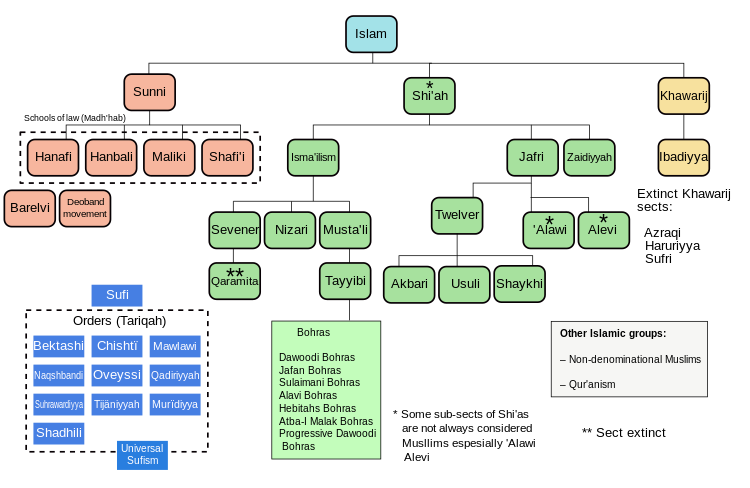


  • Sunni

The largest denomination in Islam is Sunni Islam, which makes up 75%–90% of all Muslims and is arguably the world's largest religious denomination.  Sunni Muslims also go by the name Ahl as-Sunnah which means "people of the tradition [of Muhammad]."  These hadiths, recounting Muhammad's words, actions, and personal characteristics, are preserved in traditions known as Al-Kutub Al-Sittah (six major books).

  • Shia

The Shia constitute 10–20% of Islam and are its second-largest branch.

While the Sunnis believe that a Caliph should be elected by the community, Shia's believe that Muhammad appointed his son-in-law, Ali ibn Abi Talib, as his successor and only certain descendants of Ali could be Imams.  As a result, they believe that Ali ibn Abi Talib was the first Imam (leader), rejecting the legitimacy of the previous Muslim caliphs Abu Bakr, Uthman ibn al-Affan and Umar ibn al-Khattab.  Another point of contention is the cursing of figures revered by Sunnis.  However, Jafar al-Sadiq himself disapproved of people who disapproved of his great grand father Abu Bakr and Zayd ibn Ali revered Abu Bakr and Umar.  More recently, Grand Ayatollah Ali al-Sistani condemned the practice

  • Sufism

Sufism, or tasawwuf (Arabic: ??????), is a mystical-ascetic approach to Islam that seeks to find a direct personal experience of God.  It is not a sect of Islam and its adherents belong to the various Muslim denominations.  Classical Sufi scholars have focused on the reparation of the heart and turning it away from all else but God by making use of "intuitive and emotional faculties" that one must be trained to use.  Hasan al-Basri was inspired by the ideas of piety and condemnation of worldliness preached by Muhammad and these ideas were later further developed by Al-Ghazali.  Traditional Sufis, such as Bayazid Bastami, Jalaluddin Rumi, Haji Bektash Veli, Junaid Baghdadi, and Al-Ghazali, argued for Sufism being based upon the tenets of Islam and the teachings of Muhammad.

ISIS (aka ISIL)

The Islamic State of Iraq and the Levant (ISIL, IPA /?a?s?l/), also known as the Islamic State of Iraq and Syria (ISIS, /?a?s?s/), Islamic State (IS), and by its Arabic language acronym Daesh (Arabic: ?????? d??ish, IPA: [?da????]), is a Salafi jihadist unrecognized proto-state and militant group that follows a fundamentalist, Wahhabi doctrine of Sunni Islam.

ISIL is a theocracy, proto-state and a Salafi or Wahhabi group.  It follows an extremist interpretation of Islam, promotes religious violence, and regards Muslims who do not agree with its interpretations as infidels or apostates.

The 'West' also are seen as infidels by ISIS.  And there (false) interpretation of Islam says they have an obligation to kill those who they see as infidels.

Now - Why Muslims are not a threat to America:
  • There are approximately 1,600,000,000.00 Muslims world wide.
  • There are approximately 100,550.00 ISIS and supporters world wide.
Do the math.  This means 0.0063% of Muslims, world wide, follow or believe ISIS.

Note the above numbers are the latest I could find from several sites via Google.
------
So, should Americans be cowering in fear of ANY Muslim they encounter?  I say NO!

We should welcome and support Muslims in general.  And support Muslim organizations fighting against ISIS.  Example: True Islam

The truth, there will be no defeat of ISIS world wide because it is a religious-based group, we can only defeat the ISIS army, which is underway now.  The ONLY true defeat of ISIS will be by other Muslims defeating their doctrine.


Monday, December 12, 2016

ART - Of the Quran

Remember, NOT all Muslims are like ISIS.  In fact the majority think ISIS is a corruption of Islam.

"Exhibit illuminates the divine art of the Quran" PBS NewsHour 12/7/2016

Excerpt

SUMMARY:  A major exhibition on the art of the Quran is being billed as the first of its kind in the U.S.  Sixty-eight of the most important and exquisite Qurans ever produced are on view now at the Smithsonian's Sackler Gallery in Washington, D.C.  Jeffrey Brown reports on the vast variety of manuscripts on display and the beauty, history and hard work behind each masterpiece.

JUDY WOODRUFF (NewsHour):  In the charged atmosphere at this time around the role of Muslims in America comes what is billed as the first major exhibition on in the United States on the Quran.

Jeffrey Brown reports.

MASSUMEH FARHAD, Arthur M.  Sackler Gallery, Smithsonian Institution:  This is one of the great highlights of the exhibition.  It's a Quran from the early 14th century, from about 1330, signed by a great master.

JEFFREY BROWN (NewsHour):  Signed?

MASSUMEH FARHAD:  Signed.

JEFFREY BROWN:  Yes.

A holy book, as a work of art, the Quran, sacred to some 1.6 billion Muslims around the world.  A new exhibition at the Smithsonian Institution's Sackler Gallery in Washington, D.C., presents 68 of the most important and exquisite Qurans ever produced.

Dating from the late 7th to early 17 centuries, they come from many parts of the Islamic world and are part of the collection of the Museum of Turkish and Islamic Arts in Istanbul.  That's where Sackler chief curator Massumeh Farhad first saw them.

MASSUMEH FARHAD:  I realized that these were true works of art, that every single one of them was astounding in its sort of mastery of calligraphy, of the styles, and also of the scale of the works.

And that is something that, to me, was very important, and motivated me in trying to organize this exhibition, because I thought it really shifted my perception of what these works are.  And I'm hoping that it will also shift the perception of the visitors who come to the museum to see the exhibition.

Monday, June 20, 2016

FROM A MUSLIM - Heartfelt Words on Orlando

"An Orlando Muslim’s heartfelt words on nightclub mass shooting" PBS NewsHour 6/15/2016

Excerpt

SUMMARY:  Rubana Khan of Orlando, in heartfelt verse, sends apologies from her Islamic family to the families of the victims of Sunday’s mass shooting.  In doing so, she lays bare the pain the killer, Omar Mateen, has caused her and other Muslims, who consider their religion one of peace, not of violence or hatred.

Monday, December 28, 2015

VIEWS ON ISLAM - Divergent Voices

"How do we reconcile today’s divergent voices of Islam?" PBS NewsHour 12/23/2015

IMHO:  ISIS is NOT Islam and has no right to speak for all of Islam.

Excerpt

SUMMARY:  With the rise of the Islamic State group, there have been questions about just who speaks for Islam and what the message should be.  Chief foreign affairs correspondent Margaret Warner talks with Manal Omar of the United States Institute of Peace and Asra Nomani, co-founder of the Muslim Reform Movement, about standing up to violent religious extremism.

MARGARET WARNER (NewsHour):  The recent terror attacks in Paris and San Bernardino, its perpetrators inspired by jihadist ideology, have reignited a long-running debate about the nature of Islam and its links to violent extremism.

In his address after the San Bernardino killings, President Obama urged Americans not to scapegoat all Muslims.  But he also called on Muslims to combat what he described as a dangerous trend in their faith.

PRESIDENT BARACK OBAMA:  An extremist ideology has spread within some Muslim communities.  This is a real problem that Muslims must confront, without excuse.

MARGARET WARNER:  The next day, leading Republican presidential candidate Donald Trump called for a temporary ban on foreign Muslims entering the U.S. and a more watchful approach to those living here.

DONALD TRUMP, Republican Presidential Candidate:  We have to look at mosques.  And we have to respect mosques.  But, yes, we have to look at mosques.  We have no choice.  We have to see what’s happening, because something is happening in there.  Man, there’s anger.  There’s anger.  And we have to know about it.

MARGARET WARNER:  Democratic contender Hillary Clinton has taken the opposite tack in discussing Islam.

HILLARY CLINTON, Democratic Presidential Candidate:  Islam is not our adversary.  Muslims are peaceful and tolerant people, and have nothing whatsoever to do with terrorism.

MARGARET WARNER:  This debate extends to the global Muslim community as well.  Jordan’s King Abdullah, who speaks often of a war within Islam, insists Islamic State militants are way outside the mainstream.

KING ABDULLAH II BIN AL-HUSSEIN, Jordan:  These are outlaws.  These are renegades.  They have nothing to do of understanding what our religion is about.

MARGARET WARNER:  The struggle to understand and agree on what Islam represents in an age of terror is sure to continue.

And, for more, we’re joined by two Muslim American women, both former journalists.  Manal Omar is associate vice president for the Middle East and Africa Center at U.S. Institute of Peace.  And Asra Nomani is co-founder of Muslim Reform Movement.  She’s also the author of “Standing Alone:  An American Woman’s Struggle for the Soul of Islam.”

Monday, May 11, 2015

ISLAM - South Africa's Gay-Friendly Mosque

"Is Cape Town’s women and gay-friendly mosque a sign of new Muslim attitudes?" PBS NewsHour 5/9/2015

COMMENT:  I am not Muslim, in fact I'm Agnostic.  But looking at Islam from the outside has me wondering how much of orthodox Islam is cultural based.  After all the roots of Islam (and Christianity for that matter) is from an era of male dominance and cultures who treated women like possessions belonging to men.  Are extremests today refusing to let Islam evolve.

Excerpts

SUMMARY:  A Muslim academic recently opened a gay- and women-friendly mosque in Cape Town, South Africa, which was largely regarded as a response to the culture of exclusion and conservatism in the Muslim faith.  And despite receiving death threats and fierce criticism, experts say the house of worship's policies represent an adaptation of centuries-old traditions.  Martin Seemungal reports.

MARTIN SEEMUNGAL (NewsHour):  The call to prayer at Cape Towns newest mosque, which advertises itself as one of a kind in South Africa.

TAJ HARGEY:  We are the only mosque by the way in the whole country that has the words all welcome.  We chose the name open mosque to really identify what the mosque was about—it was open to all.

MARTIN SEEMUNGAL:  Sixty-year-old Taj Hargey is the man behind this new mosque– a mosque he sees worthy of being replicated in other parts of the world.

Hargey says his mosque is open to non-muslims, homosexuals—women are allowed to preach from the pulpit—they pray side by side with the men.

Tanweer is one of the few who prays here regularly ever since the Mosque opened last September.

TANWEER:  I come to this mosque every week because this is the only mosque that I know of where there’s equality in the genders, where females sit and can actually view the sermon from the front and we’re considered equals to men.

MARTIN SEEMUNGAL:  A counter, he says, to the daily stream of news and images that portray Islam as extremist and violent.

In fact, Hargey has been challenging Muslim orthodoxy for years.

Born and raised in Cape Town Hargey went abroad and studied at Oxford-he has a PHD in Religious studies.

He made headlines in Britain last year because of his ‘ban the burqa’ campaign.
-----
TAJ HARGEY:  This idea of face masking (burqa), if its an Islamic practice.  Why is it banned in mecca?  No woman which goes to mecca the holiest mosque in Islam is allowed to cover her face—so this notion that is an Islamic practice with due respect is nonsense..it may be a cultural expression..fine..it may be a personal wish..fine—If I want to put a bone through my nose—I have a right..but then do I have a right to say a bone through my nose is an Islamic thing?

Monday, March 23, 2015

YEMEN - Escalating Violence

"Why violence is on the rise in Yemen" PBS NewsHour 3/20/2015

Excerpt

SUMMARY:  Yemen’s deadliest terror attack in decades left hundreds of casualties.  Judy Woodruff talks to Nabeel Khoury, a former State Department official in Yemen, about rising violence, ethnic tensions and power struggles in that country.

JUDY WOODRUFF (NewsHour):  We want to take a closer look at today’s violence in Yemen and what it says about the state of that region.

Joining me now is Nabeel Khoury.  He had a career in the Foreign Service and was the deputy chief of mission in Yemen for the State Department from 2004 to 2007.

Welcome to the program.

NABEEL KHOURY, Former State Department Official in Yemen:  Happy to be here.

JUDY WOODRUFF:  So, a terrible situation today.  Over a hundred and, what is it, 30 were killed, over 300 wounded, worst violence in decades.  How do you explain this?

NABEEL KHOURY:  Well, this attack was perpetrated against the Houthi in principal, who are in charge in Sanaa.

But, unfortunately, a soft target was chosen, meaning a mosque, where Zaidi Yemenis go.

JUDY WOODRUFF:  Zaidi, a particular group.

NABEEL KHOURY:  Zaidism is a part of Shia Islam.  It broke off Shia Islam centuries ago.  But it’s closer to Shia Islam than it is to Sunni Islam.

Monday, November 24, 2014

WAR ON ISIS - Opinion of Syrian Sunni Cleric Critic

"Syrian cleric who led funeral prayers for Peter Kassig speaks out against Islamic State, Assad" PBS NewsHour 11/21/2014

Excerpt

JUDY WOODRUFF (NewsHour):  Earlier today, friends and family of the Islamic State’s latest Western beheading victim, aid worker Peter Kassig, said goodbye to the 26-year-old.

Chief foreign affairs correspondent Margaret Warner reports.

MARGARET WARNER (NewsHour):  Kassig, who converted to Islam after his capture in 2013 and took the name Abdul-Rahman, was memorialized this afternoon at an Indiana mosque.

Among the speakers, prominent Syrian Sunni cleric Sheik Muhammad al-Yaqoubi.  Al-Yaqoubi was among the first Syrian clerics to call on President Bashar al-Assad to step down in 2011 after government forces cracked down on peaceful protesters.  He was forced into exile later that year.

But he’s also a vocal critic of the Islamic State group.  Two months ago, he released an open letter to its leader, Abu Bakr al-Baghdadi, telling him:  “You have misinterpreted Islam into a religion of harshness, brutality, torture and murder,” which he called a great wrong and an offense to Islam.

I spoke with Sheik al-Yaqoubi yesterday.

Sheik al-Yaqoubi, thank you for joining us.

SHEIK MUHAMMAD AL-YAQOUBI:  Thank you.

MARGARET WARNER:  Why did you agree to speak at Peter Kassig’s funeral when the family asked you to?

SHEIK MUHAMMAD AL-YAQOUBI:  Well, Peter Kassig, Abdul-Rahman, sacrificed his life for the sake of the Syrian people.

He went on a humanitarian mission as an aid worker to help save humanity, to show sympathy to the Syrian people, solidarity of the American people with the Syrian people.  So it’s our duty as Syrians to stand by his family, and to stand by his community, and to stand by the American people who gave this example of bravery in this difficult time, when ISIS is slaughtering everyone.

Monday, August 25, 2014

OPINION - Islam/Muslims, a View on a Usenet Newsgroup

"Muslims And Critical Mass" by Neal Boortz, Newsgroup soc.culture.islam

My first stab at public speaking was at the Irvine Elementary School in Irvine, California.  My 8th grade teacher, Roy Henry, encouraged me to enter.   My speech on the atom and nuclear power brought me a second place behind some stupid girl.  Oh well.

I did learn one thing from that experience … the concept of critical mass.

Here’s your basic explanation.  You have a glob of weapons-grade uranium.  There’s enough radioactive material there to give off a good bit of radiation, but it’s less than a critical mass.  It will give off a specific amount of radiation for a very long time and it can most definitely hurt you, but the atomic reaction within your glob of uranium will remain under control.  Deadly .. but under control.

Now you come in with another hunk of uranium.  Again, it’s not a critical mass of uranium, so you’re just upping your exposure to radioactivity.  Somebody dares you to take the two globs of uranium and slam them together.  Uh oh … now you have gone from two sub-critical masses of uranium to one critical mass and the nuclear reaction is no longer controlled.  In fact … it’s very much OUT of control, and within a fraction of a fraction of a second the entire mass of uranium is turned into pure, raw energy.   It’s the old E=MC2 at work.  You’re now a vaporized crispy critter, as is pretty much everything within miles of you, and the landscape is scraped clean.  Why?  You just detonated an atomic bomb, that’s why.  Way to go, sport.  You just had to take that dare, didn’t you?

Where am I going with this?  To the wonderful, peaceful, gentle peaceful religion of Islam, that’s where.

Have you been watching this ISIS crowd in Iraq?  They are lopping the heads off of Christian children for being nothing more than Christian children.  These same bloodthirsty Islamic thugs stoned a woman to death in Syria last week for adultery.  I wouldn’t be surprised if the very man she committed the act of adultery with was right there throwing stones – such is the viciousness of this religion.  Would you like to see some pictures or videos of Muslims stoning women to death?  They’re on the Internet – go look.  Look at the frightened faces of these women as they’re buried up to their shoulders and these wonderful Muslim men gather around to kill them.  What an amazing religion!  And while you’re on the Internet maybe you can find pictures of these Muslim men mutilating the genitals of their young daughters.  After all, you certainly don’t want Muslim women feeling any sexual pleasure, do you?

Then there’s Hamas in Gaza.  I’m sure the fools who have been condemning Israel for fighting back against these Islamic murderers don’t want to hear this … but Israeli Defense Forces have now discovered a manual for Hamas killers telling them how to locate their rocket launching facilities near civilians, especially children, so that they can get their women (who are merely chattel) and children killed and blame Israel.  It works to a worrying extent … there are idiots all over the place who believe that Israel is the bad guy here.  As many people have commented, Hamas would kill all Israeli children if it could, but it can’t.  Israel COULD kill all Palestinian children in Gaza, but it won’t.

OK … so where does this critical mass thing come in?  You know individual Muslims, as do I.  Perhaps in a one-on-one situation you’ve found them to be engaging, intelligent and certainly not threatening.  I’m betting, though, that you’re experiences with Muslims have been in situations where they were decidedly in the minority.  Watching the reactions of Muslims in countries where they are in a decided minority, including the United States, gives you no real cause to worry.  Beheading aren’t likely.  But let those numbers increase – let their percentage of the population increase – and the danger increases, just as it will with larger globs of uranium.  Such is the case in France and Britain where Muslims have been demonstrating, sometimes rioting, as they protest.  The larger the numbers, the greater the chance for violence.  There were protests in the U.S. as well, though none were violent so far as I know.

There is, somewhere, a critical mass; a population percentage at which Muslims will cease all pretext at coexistence and tolerance will evaporate.  There is some number at which the Quran’s instructions that non-Muslims are to either be taxed, converted, or killed will get more serious consideration.  It’s happening in Iraq now to Christian populations besieged by the terrorist Islamic State.  Critical Mass.  These Christians have identifying marks on the doors outside their homes … if they don’t convert or pay the tax as instructed .. they literally lose their heads.

There’s something to be learned in the U.S. from what you haven’t seen.  That would be Muslims demonstrating against the killings of Christians, the stoning of women, and the genital mutilation of young Muslim women.  There are small and limited exceptions, to be sure, but in general Muslims don’t seem at all outraged at all at the behavior of Muslims worldwide.  That, my friends, should alarm you.  Why?  If Muslims who truly want to live in peace can’t or won’t speak out against the violence now … what is going to happen as Muslim numbers increase?  What happens when they reach the critical mass?  When the numbers are so great – and Muslim numbers are increasing faster than any other religion – that elections can be controlled and public reaction can be ignored – what happens then?

Muslim violence can be controlled now.   Those in a significant minority have this tendency to recognize their disadvantage and thus behave.  They’re below critical mass.  Do you want to sit back and wait to see what happens when that critical mass is ended?

Yes … I know that some of you are just itching to point out that pretty much all religions, including the Christian religion, can descend to violence and depravity in furtherance of their beliefs.  The Christian religion certainly has seen this.  But we’re not going to prevent what Muslims might become by pointing out what Christians or other religions once were.  And yes – there are Christians today who would gladly use force to compel others to live in accordance with their beliefs.  Though the numbers may be small, we need to be diligent in resisting their quest for power as well.

Islam is not a peaceful religion.  Christianity, by and large, is.  You certainly can’t find something in the Bible that suggests murdering people who don’t believe as you do.  This political correctness must be ended.  This threat has to be faced.  Let’s hope we in America don’t have to discover this first hand because we slept through the beginning of this crisis.

Monday, May 05, 2014

AFRICA - Senegal, Boys Forced to Beg

Note "young boys" not girls.  The brand of Islam that excludes girls education.  This practice is tantamount to child slavery.

"In Senegal, thousands of young boys forced into begging system for Koranic study" PBS NewsHour 5/2/2014

Excerpt

JUDY WOODRUFF (NewsHour):  And we travel now to Senegal, considered one of West Africa’s rising nations, home to a stable democracy with plans for universal health care and education, but where a troubling human rights crisis persists.

Kira Kay of the Bureau for International Reporting has the story.

KIRA KAY, Bureau for International Reporting:  In a sandy courtyard in the city of Saint-Louis, a group of young boys begin their evening prayer studies.  They are talibes, meaning students, and they have come 200 miles from their home villages to live with this Koranic master, called a marabout.

But their studies have only come at the end of a long, hard day’s work begging on the streets.  You see Senegal’s talibes weaving in and out of traffic with their little yellow tubs or rusty cans.  It’s dangerous, dirty work, up to 10 hours a day.  Along with morsels of food, they are hoping for money.  They owe their marabout a quota of about a dollar a day.

Begging is used to teach talibes humility and resilience.  But this marabout admits it’s also a matter of simple economics.

ALIOUNE SECK, Koranic Teacher (through interpreter):  You have to buy these books, medicine, water, electricity, everything you need in life.  And the government doesn’t give it to us.  That’s why they beg.

KIRA KAY:  Talibe aid worker Issa Kouyate says what he sees is more sinister.

ISSA KOUYATE, Maison de la Gare:  The society knows that these marabouts treat these boys like slavery.  The government knows these marabouts treat these boys like slavery.  Most of the marabouts abuse these boys.

KIRA KAY:  The talibe system is unique to West Africa, and is rooted in centuries-old tradition, says Imam Mouhamed Cherif Diop.

MOUHAMED CHERIF DIOP, Coordinator, Tostan (through interpreter):  It is assumed that I am not capable of giving my children their necessary education because of my affection, that I will tolerate things that I shouldn’t.  And so we have entrusted our children to the marabouts, who live in another village, to create this distance to permit a good education.

IMHO "good education" in this case means religious brain washing, no alternative ideas allowed, only what the marabout teach.  Which perpetuates the chauvinistic Islamic practice.

Monday, September 16, 2013

EGYPT - Political Islam?

"Is There a Future for Political Islam in Egypt?" PBS Newshour 9/13/2013

Excerpt

SUMMARY:  It's a dangerous time in Egypt to be associated with the Muslim Brotherhood, as security forces continue their crackdown on pro-Morsi supporters.  Margaret Warner reports from Cairo on their dispersed, toned-down protests, the struggle between religion and politics in Egypt and whether the crackdown will inspire more violence.

JUDY WOODRUFF (Newshour):  As we reported yesterday, the Egyptian government has extended its state of emergency in the country for another two months.  The move comes amid an ongoing crackdown on the Muslim Brotherhood, and stepped-up jihadi attacks in Egypt's Sinai region.

In her latest report from Cairo, chief foreign affairs correspondent Margaret Warner reports on the future of the Brotherhood and political Islam in the new Egypt.

MARGARET WARNER (Newshour):  Patients flown in to Cairo's El Farouq Hospital yesterday seeking low-cost care and subsidized medicines.  It's one of the two dozen hospitals in Egypt built and long supported by the Muslim Brotherhood.

When we visited this one two years ago, patients spoke proudly of its Brotherhood ties and high standards.  But now hospital director Dr. Magbi Abdul Aziz is keeping his distance from the group.

Monday, August 19, 2013

OPINION - Islamic World as Seen by an American

"The Islamic World Presently Being Torn Asunder By Civil War Mainly In Egypt, Syria and Iraq" from Seneca, NEWSNET Post 8/16/2013

There appears to be three distinct factions in this war, the Sunnis, the Shiites and the secular Muslims.  For example in Egypt the fundamentalist Muslims, mainly Saudi, (al Qaeda is Sunni) and led by the Muslim brotherhood are in a life-and-death struggle with the army which, appears to be secularist.

Obama has kept America out of this and that is good.  It still sending Egypt aid but that aid is presumably going to the Egyptian government now under control of the secular army.

However, America's aid to the Egyptian army is dwarfed by the $12 billion annual aid being provided by Saudi Arabia and the Gulf Emirates.  Now Saudi Arabia is a very fundamentalist Islamic state (Sunni) but its government ironically is secular.  Therefore, American politicians calling for the termination of aid to Egypt at this time are dead wrong.  Senators John McCain and Lindsay Graham, both fatuous Republican RINOs, have stupidly been advocating that.

In Syria the civil war is between Shiites and Sunnis also.  But the Shiite side is led by a secular despot, Bashar Assad who is actually a Sunni, but is really a secular Muslim.   The so-called rebels in Syria are led by fundamentalist jihadists and that is why the Saudi government is against them and is aiding Hassan.

Ironically we also have Shiite Iran allied with Bashar Assad.  That is because they see Assad as an enemy to Sunni jihadists who control the rebel forces.

Confusing, is it not?  Again it is the right policy for Americans, and Europeans to stay completely uninvoleved in this conflict no matter how many civilians are killed.  The West has no dog in this fight.

In Iraq it is again Sunni versus Shiite.  The West should stay clear and have no involvement whatsoever, either military or humanitarian.

Tuesday, February 12, 2013

TUNISIA - Ruling Islamists Blamed

"Ruling Islamists, Under Attack, Reject Blame for Tunisia’s Woes" by KAREEM FAHIM, New York Times 2/11/2013

Excerpt

Facing public anger and internal divisions after the assassination of an opposition leader, Tunisia’s largest Islamist party, which leads a governing coalition, blamed the news media, secular elites and the remnants of the old government for its troubles.

As Tunisians fretted about the specter of political violence, the party, Ennahda, did not seem to look inward.  It strongly condemned the assassination, but did not see any blame for the anger in its own actions.  But others did.

Its implacable critics renewed their charge that the killing was the result of Ennahda’s conservative religious agenda.  Others, including supporters of the group, said the movement’s own missteps since coming to power contributed to the public outburst after the politician Chokri Belaid was gunned down last week.  The group had lost confidence, some said, by focusing on power rather than on governing.

As tens of thousands took to the streets last week and Tunisia’s divisions were laid bare, many waited to see how Ennahda would respond.  Would it reach out to find common ground with some of its critics, or would it retreat to its base of support?  The challenge resonates here and in Egypt, where the Muslim Brotherhood is facing even harsher questions about its rule.

Ennahda’s leader, Rachid al-Ghannouchi, dismissed the criticism, saying that the movement remained popular and that a majority of Tunisians were not afraid of his group.  “Just a tiny part of the aristocracy,” he said.

Nevertheless, the anger amounted to a humbling setback for Ennahda, which had been in the vanguard of Islamists seeking political power after the Arab uprisings two years ago and had held up its record of building political consensus as a model.  After decades of being jailed, or forced underground or into exile by authoritarian leaders, the Islamist groups’ rise to power in Egypt and Tunisia has been swift.  So has the reckoning on their rule.

“They thought that governing would be easy,” said Abou Yaareb Marzouki, a philosophy professor who is close to Ennahda.  “And they imagined that through governance, they will reject forced modernism,” he said, referring to what he called a policy of westernization under colonial rulers and authoritarian governments.  But Ennahda and the Brotherhood had swung too far in the opposite direction, he suggested, imposing “forced easternization.”

Since the uprising against President Zine el-Abidine Ben Ali two years ago, Ennahda has insisted that whatever the results of elections, it would rule with others and had no intention of imposing a conservative religious agenda.  After winning a plurality in Tunisia’s first elections, the party formed a coalition with the center left.

Facing challenges that would test any government, the coalition became noted for its incompetence, failing to dent the economic crisis or reform institutions.

Ennahda was accused of coddling ultraconservatives, known as Salafis, some of whom have been tied to a string of violent episodes.

The blame intensified after the killing of Mr. Belaid, who had received death threats for his criticisms of Islamists.  At his funeral on Friday, tens of thousands of mourners directed their anger at Ennahda and Mr. Ghannouchi, blaming them for fostering extremism and taunting the leader with an incendiary chant: “Slaughterer.”

Tuesday, January 15, 2013

AFRICA - Mali Update, French Military Support

"French Troops Aid Mali in Push Back of Islamic Militants" (Part-1) PBS Newshour 1/14/2013

JEFFREY BROWN (Newshour):  And we turn to the West African nation of Mali, where a war between radical Islamists and government forces has been waged for nearly nine months.

The militants gained control of the north, some two-thirds of the country, last summer and imposed Sharia law. The United States and other Western countries have largely stayed out of the conflict, despite worries of a wider threat to the region.

That all changed Friday when the French government launched air attacks after the fighters took over a village in government-controlled territory.

We begin with this report narrated by Jonathan Miller of Independent Television News.

JONATHAN MILLER:  Three jihadist groups now deemed to pose a clear and present danger to the capital, Bamako, and beyond, a threat to Africa and Europe.

COL. PAUL GEZE, French ground commander (through translator):  The military units I command will not stay in Bamako, which will be our military base, but will go further north and combat the terrorist groups there, in addition to the airstrikes that we have undertaken in the past two days.

JONATHAN MILLER:  The operation already proving heavily dependent on those French airstrikes aimed at destroying capability, disabling, dislodging, and denying sanctuary to the jihadist groups who now occupy an area the size of France.

The Islamists are firing online counter-propaganda salvos. They're targeting Muslims again, they say. "We will destroy them in their dens."

Abd al-Wadoud, leader of al-Qaida in the Islamist Maghreb, posting this message addressed to the president of France and African leaders who support French intervention.

ABD AL-WADOUD, Al-Qaida in the Islamist Maghreb (through translator):  I direct my message to those who insist on this oppressive war. If you want peace and security, we welcome that. If you want war, we will fulfill your desire. The great Sahara Desert will be a graveyard for your soldiers.

JONATHAN MILLER:  But Francois Hollande, the president of France, has taken a carefully calculated gamble that failure to stop the advancing jihadist forces in their tracks poses an even greater risk: the creation of yet another haven for Islamist insurgents, this time not so far from Europe.

This is a propaganda video filmed by one of the three main jihadi groups, Ansar Dine. A French presidential aide has admitted they're well-trained, well-armed with sophisticated weapons looted from Libya by Tuareg rebels who had been fighting with Gadhafi.

LAURENT FABIUS, French foreign minister (through translator):  As far as the direct implication of France is concerned, it's a matter of weeks. After we provide support, we have no intention of staying long-term.

JONATHAN MILLER:  The Islamists' destruction of the Sufi Muslim shrines in Timbuktu and their administering Sharia punishments, floggings and public amputations, have scared secular Malians. And they now want urgent help to kick the jihadis out.

Even the Tuareg fighters who started the rebellion only to be overrun by the Islamists themselves say they support French intervention. And now that help has arrived.


"Northern Mali Faces Political, Economic Crisis as Islamists Gain More Control" (Part-2) PBS Newshour 1/14/2013

Excerpt

SUMMARY:  Despite French air strikes, Islamist rebels have gained more control of Mali, a nation rich in minerals and resources. Jeffrey Brown talks to the Atlantic Council's J. Peter Pham and Emira Woods of Institute for Policy Studies about advances by the insurgency to control the West African nation, where democracy has weakened.

Tuesday, December 04, 2012

PAKISTAN - Sectarian Violence

"Pakistan Reels With Violence Against Shiites" by DECLAN WALSH, New York Times 12/3/2012

Excerpt

QUETTA, Pakistan - Calligraphers linger at the gates of an ancient graveyard in this brooding city in western Pakistan, charged with a macabre and increasingly in-demand task: inscribing the tombstones of the latest victims of the sectarian death squads that openly roam these streets.

For at least a year now, Sunni extremist gunmen have been methodically attacking members of the Hazara community, a Persian-speaking Shiite minority that emigrated here from Afghanistan more than a century ago. The killers strike with chilling abandon, apparently fearless of the law: shop owners are gunned down at their counters, students as they play cricket, pilgrims dragged from buses and executed on the roadside.

The latest victim, a mechanic named Hussain Ali, was killed Wednesday, shot inside his workshop. He joined the list of more than 100 Hazaras who have been killed this year, many in broad daylight. As often as not, the gunmen do not even bother to cover their faces.

The bloodshed is part of a wider surge in sectarian violence across Pakistan in which at least 375 Shiites have died this year — the worst toll since the 1990s, human rights workers say. But as their graveyard fills, Hazaras say the mystery lies not in the identity of their attackers, who are well known, but in a simpler question: why the Pakistani state cannot — or will not — protect them.

“After every killing, there are no arrests,” said Muzaffar Ali Changezi, a retired Hazara engineer. “So if the government is not supporting these killers, it must be at least protecting them. That’s the only way to explain how they operate so openly.”

The government, already battling Taliban insurgents, insists it is taking the threat seriously. During the recent Mourning of Muhurram, when Shiites parade through the streets over 10 days, the Interior Ministry imposed stringent security measures such as blocking cellphone signals for up to 12 hours — to try to prevent remote bomb detonations — and banning doubled-up motorcycle riding. Even so, Sunni bombers struck at least five times, killing at least 50 Shiites and wounding several hundred. The Pakistani Taliban claimed responsibility for the biggest attacks, highlighting an emerging link between that group and traditional sectarian militants that has worried many.

Yet the unchecked killings have also raised wider questions about Pakistani society: about the spread of a cancerous sectarian ideology in a public that even just a decade ago seemed more tolerant, and about what might be spurring the growing audacity of the killers, some of whom are believed to have links to the country’s security services.

The murders in Quetta, for instance, involve remarkably little mystery. By wide consensus, the gunmen are based in Mastung, a dusty agricultural village 18 miles to the south that is the bustling local hub of Lashkar-e-Jhangvi, the country’s most notorious sectarian militant group.

Like so many Pakistani groups that combine guns with zealotry, Lashkar-e-Jhangvi thrives in a wink-and-nod netherworld: it is officially banned, but its leader, Malik Ishaq, was released from jail last year amid showers of rose petals thrown by supporters. Now Mr. Malik lives openly in southern Punjab Province, protected by armed men who loiter outside his door, allowing him to deliver hate-laced statements to visitors. Shiites are “the greatest infidels on earth,” he told a Reuters reporter last month.

In Quetta, his followers are similarly unfettered. In targeting the Hazara — who, with their distinctive Central Asian features, are easy to pick out — Lashkar-e-Jhangvi militants block busy highways as they search vehicles for Hazaras and daub walls with hate slogans. “The face is the target,” said Major Nadir Ali, a senior Hazara leader and retired army officer. “They see the face, then they shoot.”

Friday, November 30, 2012

EGYPT - Work on New Constitution

"With Deadline Looming, Islamist-Led Egyptian Assembly Works on Constitution" PBS Newshour 11/29/2012

Excerpt

SUMMARY: Jeffrey Brown talks to the New York Times' David Kirkpatrick about the progress of Egypt's Constitutional Assembly to wrap up work on the new Egyptian constitution before its deadline after many secular and liberal representatives have walked away from drawing table, leaving Islamists to create the road map for Egypt's future.

Monday, November 12, 2012

TUNISIA - 'Arab Spring' Revolt Legacy

"Tunisia Battles Over Pulpits, and Revolt’s Legacy" by NEIL MacFARQUHAR, New York Times 11/11/2012

Excerpt

On the Friday after Tunisia’s president fell, Mohamed al-Khelif mounted the pulpit of this city’s historic Grand Mosque to deliver a full-throttle attack on the country’s corrupt culture, to condemn its close ties with the West and to demand that a new constitution implement Shariah, or Islamic law.

“They’ve slaughtered Islam!” thundered Dr. Khelif, whom the ousted government had barred from preaching for 20 years. “Whoever fights Islam and implements Western plans becomes in the eyes of Western politicians a blessed leader and a reformer, even if he was the most criminal leader with the dirtiest hands.”

Mosques across Tunisia blazed with similar sermons that day and, indeed, every Friday since, in what has become the battle of the pulpit, a heated competition to define Tunisia’s religious and political identity.

Revolution freed the country’s estimated 5,000 officially sanctioned mosques from the rigid controls of the previous government, which appointed every prayer leader and issued lists of acceptable topics for their Friday sermons.

That system pushed a moderate, apolitical model of Islam that avoided confronting a dictator. When the system collapsed last year, ultraconservative Salafis seized control of up to 500 mosques by government estimates. The government, a proponent of a more temperate political Islam, says it has since wrested back control of all but 70 of the mosques, but acknowledges it has not yet routed the extremists nor thwarted their agenda.

“Before, the state suffocated religion — they controlled the imams, the sermons, the mosques,” said Sheik Tai’eb al-Ghozzi, the Friday Prayer leader at the Grand Mosque here. “Now everything is out of control — the situation is better but needs control.”

To this day, Salafi clerics like Dr. Khelif, who espouse the most puritanical, most orthodox interpretation of Islam, hammer on favorite themes that include putting Islamic law into effect immediately, veiling women, outlawing alcohol, shunning the West and joining the jihad in Syria. Democracy, they insist, is not compatible with Islam.

“If the majority is ignorant of religious instruction, then they are against God,” said Sheik Khatib al-Idrissi, 60, considered the spiritual guide of all Tunisian Salafis. “If the majority is corrupt, how can we accept them? Truth is in the governance of God.”

The battle for Tunisia’s mosques is one front in a broader struggle, as pockets of extremism take hold across the region. Freshly minted Islamic governments largely triumphed over their often fractious, secular rivals in postrevolutionary elections. But those new governments are locked in fierce, sometimes violent, competition with the more hard-line wing of the Islamic political movements over how much of the faith can mix with democracy, over the very building blocks of religious identity. That competition is especially significant in Tunisia, once the most secular of the Arab nations, with a large educated middle class and close ties to Europe.

The Arab Spring began in Tunisia, and its ability to reconcile faith and governance may well serve as a barometer for the region.

Some analysts link the assertive Tunisian Salafi movement to what they consider a worrying spread of violent extremism across North Africa — including an affiliate of Al Qaeda seizing control of northern Mali; a murderous attack on the American diplomatic mission in Benghazi, Libya; a growing jihadi force facing Israel in the Sinai; and a mob looting an American school and parts of the United States Embassy in Tunis.

Senior government officials said the various groups share an ideology and are in contact with one another, suggesting that while they are scattered and do not coordinate their operations, they reinforce one another’s agendas. There have been several episodes of jihadists caught smuggling small arms from Libya to Mali or Algeria across Tunisia, for example, including two small trucks packed with Kalashnikovs and some manner of shoulder-fired missiles or grenades in June, said Ali Laarayedh, the interior minister.

COMMENT: The 'West' (including the U.S.) need to take heed of the last paragraph above. It is very hard, or near impossible, to counter a religious movement and it can never be done by military means.

Wednesday, October 10, 2012

PAKISTAN - 14 Year-Old Girl Shot by Taliban

Reminder to all religious zealots and fanatics in the U.S. who continue to try to use the law to impose your religious on other citizens; the Taliban, and Iran, represent what you get when you do NOT actually practice freedom of religion and separation of church and state.

"Taliban Gun Down Girl Who Spoke Up for Rights" by DECLAN WALSH, New York Times 10/9/2012

Excerpt

At the age of 11, Malala Yousafzai took on the Taliban by giving voice to her dreams. As turbaned fighters swept through her town in northwestern Pakistan in 2009, the tiny schoolgirl spoke out about her passion for education — she wanted to become a doctor, she said — and became a symbol of defiance against Taliban subjugation.

On Tuesday, masked Taliban gunmen answered Ms. Yousafzai’s courage with bullets, singling out the 14-year-old on a bus filled with terrified schoolchildren, then shooting her in the head and neck. Two other girls were also wounded in the attack. All three survived, but late on Tuesday doctors said that Ms. Yousafzai was in critical condition at a hospital in Peshawar, with a bullet possibly lodged close to her brain.

A Taliban spokesman, Ehsanullah Ehsan, confirmed by phone that Ms. Yousafzai had been the target, calling her crusade for education rights an “obscenity.”

“She has become a symbol of Western culture in the area; she was openly propagating it,” Mr. Ehsan said, adding that if she survived, the militants would certainly try to kill her again. “Let this be a lesson.”

The Taliban’s ability to attack Pakistan’s major cities has waned in the past year. But in rural areas along the Afghan border, the militants have intensified their campaign to silence critics and impose their will.

That Ms. Yousafzai’s voice could be deemed a threat to the Taliban — that they could see a schoolgirl’s death as desirable and justifiable — was seen as evidence of both the militants’ brutality and her courage.

“She symbolizes the brave girls of Swat,” said Samar Minallah, a documentary filmmaker who has worked among Pashtun women. “She knew her voice was important, so she spoke up for the rights of children. Even adults didn’t have a vision like hers.”

Ms. Yousafzai came to public attention in 2009 as the Pakistani Taliban swept through Swat, a picturesque valley once famed for its music and tolerance and as a honeymoon destination.

Her father ran one of the last schools to defy Taliban orders to end female education. As an 11-year-old, Malala — named after a mythic female figure in Pashtun culture — wrote an anonymous blog documenting her experiences for the BBC. Later, she was the focus of documentaries by The New York Times and other media outlets.

“I had a terrible dream yesterday with military helicopters and the Taliban,” she wrote in one post titled “I Am Afraid.”

The school was eventually forced to close, and Ms. Yousafzai was forced to flee to Abbottabad, the town where Osama bin Laden was killed last year. Months later, in summer 2009, the Pakistani Army launched a sweeping operation against the Taliban that uprooted an estimated 1.2 million Swat residents.

The Taliban were sent packing, or so it seemed, as fighters and their commanders fled into neighboring districts or Afghanistan. An uneasy peace, enforced by a large military presence, settled over the valley.

Ms. Yousafzai grew in prominence, becoming a powerful voice for the rights of children. In 2011, she was nominated for the International Children’s Peace Prize. Later, Yousaf Raza Gilani, the prime minister at the time, awarded her Pakistan’s first National Youth Peace Prize.

Mature beyond her years, she recently changed her career aspiration to politics, friends said. In recent months, she led a delegation of children’s rights activists, sponsored by UNICEF, that made presentations to provincial politicians in Peshawar.

Tuesday, September 25, 2012

IRAQ - The Spillover From Syrian Civil War

"Syrian War’s Spillover Threatens a Fragile Iraq" by TIM ARANGO, New York Times 9/24/2012

Excerpt

The civil war in Syria is testing Iraq’s fragile society and fledgling democracy, worsening sectarian tensions, pushing Iraq closer to Iran and highlighting security shortcomings just nine months after American forces ended their long and costly occupation here.

Fearing that Iraq’s insurgents will unite with extremists in Syria to wage a two-front battle for Sunni dominance, Prime Minister Nuri Kamal al-Maliki recently ordered guards at the western border to block adult men, even husbands and fathers with families in tow, from crossing into Iraq along with thousands of refugees seeking to escape the grinding war next door.

Farther north, Iraqi officials have another concern, also related to the fighting across the border. Turkish warplanes have stepped up attacks on the mountain hide-outs of Kurdish insurgents galvanized by the war in Syria, underscoring Iraq’s inability to control its own airspace.

The hardening of the antagonists’ positions in Syria — reverberating across Iraq — was made clear Monday at the United Nations when the new special envoy for Syria, Lakhdar Brahimi, gave a bleak appraisal of the conflict to the Security Council and said he saw no prospect for a breakthrough anytime soon.

The Syrian war’s spillover has called attention to uncomfortable realities for American officials: despite nearly nine years of military engagement, an effort that continues today with a $19 billion weapons sales program, Iraq’s security is uncertain and its alliance with the theocratic government in Tehran is growing. Iraq’s Shiite-dominated leadership is so worried about a victory by Sunni radicals in Syria that it has moved closer to Iran, which shares a similar interest in supporting the Syrian president, Bashar al-Assad.

There is already some indication that Sunni insurgents in Iraq have tried to coordinate with Syrian fighters to set off a regional sectarian war, Iraqi tribal leaders said.

“Fighters from Anbar went there to support their sect, the Sunnis,” said Sheik Hamid al-Hayes, a tribal leader in Anbar Province, in western Iraq, who once led a group of former insurgents who switched sides and joined the Americans in fighting Al Qaeda in Iraq.
