Showing posts with label Muslim World. Show all posts

Monday, August 19, 2019

KASHMIR - India's Crackdown

One solution, although not likely to happen, is make Kashmir and independent nation.

"How people of Kashmir are reacting to India’s crackdown" PBS NewsHour 8/16/2019

Excerpt

SUMMARY:  Nearly 4 million people in Kashmir have been confined to their homes in a total communications blackout since Indian Prime Minister Narendra Modi stripped the primarily Muslim state of its semi-autonomous status 13 days ago.  Amna Nawaz reports and talks to Surabhi Tandon, special correspondent for France 24, about how civilians are handling the situation and why there hasn’t been more resistance.

Monday, August 12, 2019

DISPUTED LAND - Kashmir

"How India’s revoking of autonomy for Kashmir could lead to increased violence" PBS NewsHour 8/8/2019

Excerpt

SUMMARY:  Government forces in riot gear are patrolling Kashmir, four days after India announced a change to the contested territory’s political status.  Until then, India’s only Muslim-majority region had enjoyed a high degree of autonomy.  Nick Schifrin talks to retired [Ambassador] Frank Wisner about the decades-long dispute between India and Pakistan over Kashmir and what’s at stake.

Monday, July 01, 2019

RISING TENSIONS - Trump v Iran

"Amid elevated tensions, Trump announces new sanctions on Iran" PBS NewsHour 6/24/2019

Excerpt

SUMMARY:  After tensions with Iran nearly resulted in U.S. airstrikes last week, President Trump has fired a different type of weapon, levying new economic sanctions specifically targeting the Islamic Republic’s supreme leader.  At the same time, top U.S. officials pursued diplomatic measures while visiting the Middle East.  But Iran said the U.S. is the aggressor.  Nick Schifrin reports.

Monday, April 29, 2019

ISIS - Caliphate Lost But Not Defeated

"Despite loss of caliphate, why ISIS is ‘far from defeated’" PBS NewsHour 4/25/2019

Excerpt

SUMMARY:  The deadly Easter Sunday attacks in Sri Lanka have refocused attention on the Islamic State, which claims connection to the eight believed suicide bombers.  Judy Woodruff talks to Rukmini Callimachi of The New York Times about indicators of the terror group’s influence on the Sri Lanka attacks and how ISIS maintains robust media presence and recruiting levels.

Monday, April 22, 2019

AMERICAN POLITICS - Bully Trump vs Ilhan Omar

"Trump escalates feud with Rep. Ilhan Omar" PBS NewsHour 4/15/2019

Excerpt

SUMMARY:  President Trump has again gone on the offensive toward Rep. Ilhan Omar (D-Minn).  On Friday, he Tweeted a 9/11 video alongside Omar’s comments about the terrorist attacks, which critics said downplayed them.  Rep. Omar says she has since been threatened.  As Yamiche Alcindor reports, House Speaker Nancy Pelosi and Democratic 2020 candidates criticized the President for his incendiary rhetoric.


Monday, April 08, 2019

AFTER ISIS - Caliphate’s Capital City, Raqqa

"After the fall of ISIS caliphate, its capital remains a city of the dead" PBS NewsHour 4/4/2019

Excerpt

SUMMARY:  Although the Islamic State’s physical territory has dissolved, immense destruction from the brutal battle to eradicate the militant group remains.  In the former caliphate’s capital city, Raqqa, survivors sort through the wreckage in search of bodies, recalling the atrocities they’ve seen in this city of the dead.  Special correspondent Jane Ferguson reports from Raqqa.

Monday, March 25, 2019

SYRIA - Collapse of the Caliphate and New Threats

We may have defeated the ISIS army but you do not defeat a religious movement with military action.

"As caliphate collapses, new ISIS threats emerge in Syria" PBS NewsHour 3/19/2019

Excerpt

SUMMARY:  After nearly five years of fighting, a U.S.-led coalition has almost completely destroyed what's known as the territorial caliphate, the Islamic pseudo-state created in Iraq and Syria by ISIS--but that doesn’t mean the end of the terror group.  Amna Nawaz talks to special correspondent Jane Ferguson for an on-the-ground look at what war has left behind in Syria and the threat that remains.

Monday, February 18, 2019

END OF THE CALIPHATE - What About the ISIS Fighters?

"What should happen to thousands of foreign ISIS fighters?" PBS NewsHour 2/15/2019

Excerpt

SUMMARY:  In Syria, U.S.-backed Kurdish forces are retaking the final territory of the Islamic State.  As the caliphate dissolves, however, what will happen to the 40,000 foreign fighters who joined the terror group’s ranks over the past few years?  Many of them have been detained, but the path for prosecuting them, and preventing them from driving an ISIS resurgence, remains unclear.  Nick Schifrin reports.

Monday, September 03, 2018

UNITED NATIONS - Rohingya Atrocities

"Amid ‘mounting evidence of atrocities,’ UN calls for investigation into Rohingya crackdown" PBS NewsHour 8/27/2018

Excerpt

SUMMARY:  The U.N. is calling for an investigation into Myanmar’s violent crackdown last year against the Rohingya, a Muslim minority group.  But Rohingya refugees in Bangladesh are finally receiving aid, and despite repatriation discussions, many are reluctant to return to the people who brutalized them.  Nick Schifrin talks to special correspondent Tania Rashid and Refugees International's Dan Sullivan.

Monday, June 25, 2018

SAUDI ARABIA - One Small Win for Women's Rights

"Saudi women are finally in the driver’s seat, but not of their own lives" PBS NewsHour 6/22/2018

Excerpt

SUMMARY:  Saudi Arabia has banned women from driving since the 1950s, and is the only country in the world to do so.  But this Sunday that prohibition ends.  Nick Schifrin looks at the state of women's rights in the kingdom, and the long and winding road to allow females behind the wheel.

Monday, May 21, 2018

TRUMP AGENDA - Jerusalem Embassy, Scuttling Peace Process

"Carnage and celebration mark U.S. Embassy opening in Jerusalem" PBS NewsHour 5/14/2018

Excerpt

SUMMARY:  As the United States opened its new embassy in Jerusalem, Israeli security forces shot dead dozens of Palestinian protesters in Gaza, and reportedly wounded more than 2,000 others.  Blanket denunciations are sweeping across the Arab and Muslim world, blasting both the embassy move and the killings.  Special correspondent Jane Ferguson joins Judy Woodruff for more.


"How the world is reacting to Gaza border bloodshed" PBS NewsHour 5/15/2018

Excerpt

SUMMARY:  It was a day for burying the dead in Gaza, with nearly 60 funerals in 24 hours, while the wounded continue to overwhelm hospital staff and supplies.  Monday became the deadliest day since the 2014 war as Americans opened the new U.S. Embassy in Jerusalem.  And there was more violence along the border on Tuesday, where at least two Palestinians were killed by Israeli gunfire.  Nick Schifrin reports.


"Harsh living conditions in Gaza fuel little-to-lose mentality" PBS NewsHour 5/15/2018

Excerpt

SUMMARY:  Palestinians have been protesting for weeks for the right to leave Gaza; in the last two days, tens of thousands have joined in.  Under an 11-year blockade by Israel and Egypt, life there has become a painful struggle.  Unemployment stands at 40 percent, with few prospects for the young, and most Gazans cannot afford a generator during lengthy power cuts.  Special correspondent Jane Ferguson reports.


"Would alleviating Gaza humanitarian concerns ease violence?" PBS NewsHour 5/15/2018

Excerpt

SUMMARY:  U.S. officials are blaming Hamas for the deadly violence on the Gaza border.  Daniel Shapiro, former U.S. ambassador to Israel, says the group has long squandered its resources in trying to attack Israel, leading to "horrific" humanitarian concerns in Gaza.  Shapiro joins Nick Schifrin to discuss whether the clashes could fray alliances, and the decision to move the U.S. Embassy to Jerusalem.

Monday, March 19, 2018

SYRIA - War Keeps Raging

"Syria’s war keeps raging, amid threats of a new Hezbollah-Israel conflict" PBS NewsHour 3/15/2018

Excerpt

SUMMARY:  What began seven years ago as an uprising against the Assad regime has become a regional proxy war.  Now there is talk of another war in the offing, one between Hezbollah and Israel.  What would that look like, and how would it differ from the 2006 conflict?  Special correspondent Jane Ferguson joins Judy Woodruff to discuss the growing fears, Iran’s influence, and the bombardment of Eastern Ghouta.

Monday, March 12, 2018

WOMEN'S MOVEMENT - Meaning for Afghanistan

"What more women in government would mean for Afghanistan" PBS NewsHour 3/5/2018

Excerpt

SUMMARY:  War is a reality of life in Afghanistan, but it's not all-consuming, say a delegation of Afghan women leaders who recently visited Washington.  The country is also undergoing significant social and cultural shifts around gender and leadership.  Judy Woodruff talks with Shaharzad Akbar, a senior advisor to President Ghani, and Muqaddesa Yourish of Afghanistan's Civil Service Commission.

Monday, December 11, 2017

RELIGION - Iran Rising in Iraq (3 parts)

"Does Iran’s deep religious influence in Iraq translate to politics?" PBS NewsHour 12/6/2017

Excerpt

SUMMARY:  During the rule of Saddam Hussein, few Iranians dared to make the religious pilgrimage to the holy city of Karbala in Iraq.  But the toppling of Saddam has drawn millions of worshippers back, revealing Iran's powerful influence there.  In the first of three reports, special correspondent Reza Sayah explores the scope of and limits on that influence, in collaboration with the Pulitzer Center on Crisis Reporting.


"This Iran-backed militia helped save Iraq from ISIS.  Now Washington wants them to disband" PBS NewsHour 12/7/2017

Excerpt

SUMMARY:  In 2014, when most U.S.  ground forces were gone and Iraqi forces were too weak, the threat of ISIS in Iraq spawned the PMF, a government-sanctioned militia that was armed, funded and trained by Iran, America's long-time foe.  In the second installment of our series “Iran Rising in Iraq,” special correspondent Reza Sayah reports in partnership with the Pulitzer Center on Crisis Reporting.


"After fighting common enemy ISIS, how will rising tensions between U.S. and Iran affect Iraq?" PBS NewsHour 12/8/2017

Excerpt

SUMMARY:  In a 2016 offensive to take Mosul back from ISIS, the U.S. and Iran fought on the same side without ever publicly acknowledging it.  The militant group defeated, both countries still have a stake in Iraq and tensions have been rising.  Special correspondent Reza Sayah has the final installment of our series Iran Rising in Iraq, in partnership with the Pulitzer Center on Crisis Reporting.

Monday, October 16, 2017

TRUE ISLAM - What it Really Means


This is what Islam REALLY is.

NOT what the murderous fanatics of ISIS profess.  Also, Islam does not have a single person (no matter what the ISIS leader clams) that speaks for all of Islam.


Monday, August 21, 2017

NEWSHOUR BOOKSHELF - The Anatomy of Terror

"New book traces the evolution of terrorism since bin Laden" PBS NewsHour 8/15/2017

Excerpt

SUMMARY:  Ali Soufan, a former FBI counterterrorism agent who identified the 9/11 hijackers, felt both joy and worry the night Osama bin Laden was killed.  He worried that the U.S. didn't have a strategy to combat bin Laden's message, which lived on even though the Al-Qaeda leader was dead.  The evolution of terrorism is the subject of his new book, "The Anatomy of Terror.”  Soufan joins Margaret Warner.

MARGARET WARNER (NewsHour):  You, in almost a novelistic way, look at bin Laden or al-Zarqawi, who was the head of al-Qaeda in Iraq; or Baghdadi, the head of ISIS.

ALI SOUFAN:  Ya.

MARGARET WARNER:  Was there a common thread among them?

ALI SOUFAN, Author, “The Anatomy of Terror:  Well, ya, absolutely.  And the common thread is their own belief.

It is people who believe that there is an ongoing war between the West and the United States.  And anyone who does not in their way of interpreting events around the world is an infidel, regardless if you're a Muslim or you're not a Muslim.  That doesn't matter.

And that's why almost 95 percent of the victims of this form of terrorism are Muslims.

Monday, March 20, 2017

NEWSHOUR BOOKSHELF - "Exit West"

"Magical novel 'Exit West' explores what makes refugees leave home" PBS NewsHour 3/16/2017

Excerpt

SUMMARY:  In "Exit West," a city in the Muslim world is plunged into violence and two lovers join the mass migration of our time.  Mohsin Hamid's story about refugees is a novel, not journalism, but it combines the surreal with the very real.  Hamid sits down with Jeffrey Brown to discuss what inspired him and why he says he's seeing a "failure of imagination" around the world.

JEFFREY BROWN (NewsHour):  An unnamed city in the Muslim world is plunged into violence, and two young lovers are forced to flee, becoming a small part of the mass migrations of our era.  But they travel through time and space through magic doors.

Exit West” is a novel combining the very real with the almost surreal, imagining individuals behind today's headlines.

Author Mohsin Hamid has spent parts of his life in the U.S. and Europe.  He now lives in his native city of Lahore, Pakistan.

And nice to see you again.

MOHSIN HAMID, Author, “Exit West”:  Nice to see you.

JEFFREY BROWN:  This is in one way a very up-to-the-minute look at the dislocation of individual lives, but, of course, it's not journalism.  It's art.  It's a novel.

Tell me how you thought about what you were after.

MOHSIN HAMID:  Well, I have been moving around my whole life, California, Pakistan, London, New York, Pakistan again.

And I wanted to write about the experience of migration.  And I also felt this resistance to migrants was growing, and I wanted to write in response to that.

Tuesday, March 07, 2017

MUSLIMS - The Reality of Threat to America

Just after the 9/11 Attack I started to look at Islam under the rubric of 'know thy enemy' (my military training).

In the Alternate-Universe of Trump Land and his supporters, there has been total distortion of the threat Muslims pose to America.

I have read up on Islam (the religion) and Muslims (those who practice Islam) and I know that the vast majority are NO THREAT to America.  Islam is a peaceful religion, at least as peaceful as any religion including Christianity.

"Islam is a verbal noun originating from the triliteral root s-l-m which forms a large class of words mostly relating to concepts of wholeness, submission, safeness and peace."

Denominations
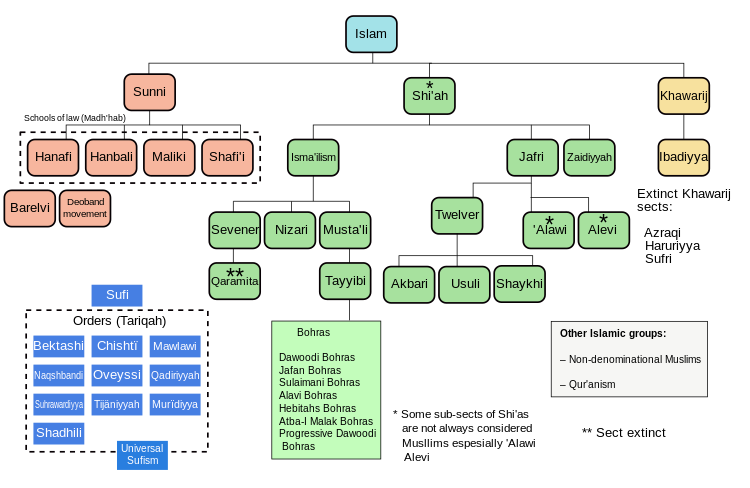


  • Sunni

The largest denomination in Islam is Sunni Islam, which makes up 75%–90% of all Muslims and is arguably the world's largest religious denomination.  Sunni Muslims also go by the name Ahl as-Sunnah which means "people of the tradition [of Muhammad]."  These hadiths, recounting Muhammad's words, actions, and personal characteristics, are preserved in traditions known as Al-Kutub Al-Sittah (six major books).

  • Shia

The Shia constitute 10–20% of Islam and are its second-largest branch.

While the Sunnis believe that a Caliph should be elected by the community, Shia's believe that Muhammad appointed his son-in-law, Ali ibn Abi Talib, as his successor and only certain descendants of Ali could be Imams.  As a result, they believe that Ali ibn Abi Talib was the first Imam (leader), rejecting the legitimacy of the previous Muslim caliphs Abu Bakr, Uthman ibn al-Affan and Umar ibn al-Khattab.  Another point of contention is the cursing of figures revered by Sunnis.  However, Jafar al-Sadiq himself disapproved of people who disapproved of his great grand father Abu Bakr and Zayd ibn Ali revered Abu Bakr and Umar.  More recently, Grand Ayatollah Ali al-Sistani condemned the practice

  • Sufism

Sufism, or tasawwuf (Arabic: ??????), is a mystical-ascetic approach to Islam that seeks to find a direct personal experience of God.  It is not a sect of Islam and its adherents belong to the various Muslim denominations.  Classical Sufi scholars have focused on the reparation of the heart and turning it away from all else but God by making use of "intuitive and emotional faculties" that one must be trained to use.  Hasan al-Basri was inspired by the ideas of piety and condemnation of worldliness preached by Muhammad and these ideas were later further developed by Al-Ghazali.  Traditional Sufis, such as Bayazid Bastami, Jalaluddin Rumi, Haji Bektash Veli, Junaid Baghdadi, and Al-Ghazali, argued for Sufism being based upon the tenets of Islam and the teachings of Muhammad.

ISIS (aka ISIL)

The Islamic State of Iraq and the Levant (ISIL, IPA /?a?s?l/), also known as the Islamic State of Iraq and Syria (ISIS, /?a?s?s/), Islamic State (IS), and by its Arabic language acronym Daesh (Arabic: ?????? d??ish, IPA: [?da????]), is a Salafi jihadist unrecognized proto-state and militant group that follows a fundamentalist, Wahhabi doctrine of Sunni Islam.

ISIL is a theocracy, proto-state and a Salafi or Wahhabi group.  It follows an extremist interpretation of Islam, promotes religious violence, and regards Muslims who do not agree with its interpretations as infidels or apostates.

The 'West' also are seen as infidels by ISIS.  And there (false) interpretation of Islam says they have an obligation to kill those who they see as infidels.

Now - Why Muslims are not a threat to America:
  • There are approximately 1,600,000,000.00 Muslims world wide.
  • There are approximately 100,550.00 ISIS and supporters world wide.
Do the math.  This means 0.0063% of Muslims, world wide, follow or believe ISIS.

Note the above numbers are the latest I could find from several sites via Google.
------
So, should Americans be cowering in fear of ANY Muslim they encounter?  I say NO!

We should welcome and support Muslims in general.  And support Muslim organizations fighting against ISIS.  Example: True Islam

The truth, there will be no defeat of ISIS world wide because it is a religious-based group, we can only defeat the ISIS army, which is underway now.  The ONLY true defeat of ISIS will be by other Muslims defeating their doctrine.


Monday, February 06, 2017

TRUMP AGENDA - Anti-Refugee

"Refugee ban ‘a gift to those that hate us,' says Madeleine Albright" PBS NewsHour 1/30/2017

Excerpt

SUMMARY:  President Donald Trump's executive order concerning refugees and visa-holders has sparked protests and backlash across the nation and overseas.  Former Secretary of State Madeleine Albright joins Judy Woodruff to share her rebuke of the White House ban, as well as controversial changes adding Stephen Bannon to the National Security Council.

JUDY WOODRUFF (NewsHour):  Now, for more on the executive order on refugees and visa holders and changes the President to the makeup of the National Security Council, we turn first to former Secretary of State Madeleine Albright.  She served as the United States' top diplomat during the Clinton administration.

When we spoke a short time ago, I began by asking her reaction to the Trump White House ban on immigrants from seven countries.

MADELEINE ALBRIGHT, Former U.S. Secretary of State:  Judy, I'm appalled, because it's done everything except keep America safer.

And let me just say, I kind of have looked at things thinking that they made this executive action without really understanding what it's all about.  So, it was unprepared, I would say, because they didn't really see how the government works.  They didn't really contact the various departments that are part of this homeland security, trying to figure out what would happen once you do something like this from the Oval Office.

So, unprepared.  And then I think, also, part of the problem was, they didn't understand what I say the unintended consequences of this, because the truth is that the countries that have been designated are now reacting, creating more problems for us, and then banning people — our people from going there.

For instance, in Iraq, how do we protect our troops?  What about the people that are interpreting?  And then I think all of it is based on untrue facts.  And so I think it is a very serious problem in terms of how the whole system works.

JUDY WOODRUFF:  Well, let me take a couple of those, one at a time.

What they're saying is if — they're saying, if they had let the rest of the government know what they were doing, that it would have leaked, and they said there would have been a flood of people trying to get in.  And they also say that they're basically only following what the Obama administration had done a few years ago in listing countries that were the most for the United States to fear in terms of terrorism.

MADELEINE ALBRIGHT:  Well, the latter is true.

What was happened was, there was an incident where something was coming out of Iraq.  They were concerned about what the facts really were.  They wanted to re-vet some people.  They didn't have enough manpower to do that, so things slowed down.

So there is nothing like that happened in the Obama administration.  I think the excuse about not letting others know, first of all, they need to understand that the government, in fact, when people trust each other, doesn't leak out when it's an important issue.

But how can you not let the departments that have something to do with executing the order not know?  Because I think that they were genuinely surprised by, you know how slow it was, what happened when they detained people, what happened then when there were demonstrations against it.

So I'm willing to say they were surprised at the reaction to it, but that's a sign of the fact they didn't understand what they were doing.


"Will the refugee ban reinforce political division?" PBS NewsHour 1/30/2017

Excerpt

SUMMARY:  President Donald Trump had promised a crackdown on immigration on the campaign trail.  Now he's done it, following through with a ban on refugees that was popular with his supporters.  Amy Walter of The Cook Political Report and Tamara Keith of NPR, join Judy Woodruff to discuss the political effects of the President's executive order restricting immigration and more.


"How Trump's immigration ban is jeopardizing one Iraqi translator's future in America" PBS NewsHour 1/30/2017

Excerpt

SUMMARY:  After seven years of working alongside the U.S. military, Abdul Hamid Abdul Ghani was set to move to live in the United States with his family next week.  Now President Donald Trump's executive order has left their future uncertain.  Special correspondent Jane Ferguson reports from Northern Iraq.


"The legal arguments for and against Trump's immigration ban" PBS NewsHour 1/31/2017

Excerpt

SUMMARY:  Lawsuits have challenged President Donald Trump's executive order that temporarily prohibits immigrants and visitors from seven countries.  Jonathan Turley a law professor at George Washington University, and Neal Katyal former Acting Solicitor General under President Obama, join Miles O'Brien to discuss whether Trump's policy violates the law or [U.S.] Constitution.

Monday, January 30, 2017

TRUMP AGENDA - Immigration

Based on fear, unfairly targets 'the others' as a danger to America.  A betrayal of American values.

"What do Trump's new orders on immigration really do?" PBS NewsHour 1/25/2017

Excerpt

SUMMARY:  President Trump is tackling one of his election promises by ordering a border wall and cracking down on illegal immigration by stripping funding from “sanctuary cities” and ending a policy of releasing undocumented immigrants.  Judy Woodruff gets views on what these moves mean from Marielena Hincapie of the National Immigration Law Center and Jessica Vaughan of the Center for Immigration Studies.

JUDY WOODRUFF (NewsHour):  We take a deeper look now at President Trump's executive actions on immigration and border security with Marielena Hincapie, the executive director of the National Immigration Law Center.  It's an immigrant rights group.  And Jessica Vaughan, she's from the Center for Immigration Studies, which advocates for tougher border security.

And we welcome both of you to the program.

Marielena, I'm going to start with you.

Overall reaction to what the President had to say today?

MARIELENA HINCAPIE, Executive Director, National Immigration Law Center:  Well, Judy, we are — we find this announcement today as an extremist policy.

I think President Trump's campaign rhetoric that was anti-immigrant, xenophobic, anti-refugee, anti-Muslim today is becoming a harsh reality.  And it's sending a message of great fear to immigrant communities across the country.

JUDY WOODRUFF:  Jessica Vaughan, reaction to what he had to say overall?

JESSICA VAUGHAN, Center for Immigration Studies:  This is a very impressive set of actions.  He really went big.

But that is what was needed to restore integrity to our immigration system, and to not only secure the border, but also restart interior enforcement, which has collapsed in the last few years, and shine that not only do we need border security, but it has to be backed up by policies that make sure that people cannot game our system.

You know, the end to the catch and release system that's been in place for the last few years is going to make a big difference in deterring future illegal immigration.  And that's important.  We needed to start sending that message to people that they aren't going to be able to get away with just getting to the United States, getting in, and then being home-free from enforcement.
