Showing posts with label presidential elections. Show all posts

Monday, November 08, 2021

MILITARY.COM - Military Storming Capital 1/6/2021


"What Happened to Members of the Military Accused of Storming the Capitol on January 6?" by Steve Beynon and Konstantin Toropin, Military.com 11/5/2021

At least five service members allegedly were part of the deadly pro-Trump mob that assaulted the U.S. Capitol on Jan. 6, leaving behind a ransacked house of government and injured police.

The attack shook the core of democracy in America, with looting and violence as Congress certified the presidential election results.  The sudden unrest forced lawmakers to hide in offices and barricade doors as rioters chanted threats.

Ten months later, the military is finally starting to take action against some of the identified participants of the event.  But most of those accused appear to still be in uniform, serving the country they allegedly attacked.

The five service members are a diverse group.  There are two officers, along with three enlisted.  Four are in the Army and National Guard, and one is in the Marine Corps.  Common to all five are pending federal charges for their actions around and inside the Capitol, and the lack of a clear and decisive response from military leaders.

"I think the way the military is handling insurrectionists, treating them with kid gloves, is another great example of how broken the system is," Kristofer Goldsmith, an Army veteran and CEO of Sparverius, an intelligence firm that researches online extremism and disinformation campaigns, said in an interview.  "There's no excuse for insurrection; it should be treated as the most serious crime someone who swore an oath to the Constitution can commit."

Pentagon officials have been adamant that they are working swiftly to weed out extremists from military service, and that all appropriate action has been taken to discipline service members who participated in the Jan. 6 attack while court cases are ongoing.

Defense Secretary Lloyd Austin is "comfortable that the civilian and military leadership of each of the services are working through appropriately each of these cases," Pentagon spokesman John Kirby told Military.com on Oct. 27.

The Pentagon has struggled with extremism in the ranks, or even to understand the scope of the issue, as troops become attractive targets for recruitment to radical causes.  The issue is highlighted by the services' slowness in punishing or discharging those allegedly involved in the Capitol mob.

The most decisive response from military leadership so far came in the case of Army Sgt. Timothy Hale-Cusanelli, who was demoted to private and booted from the force in June.  The discharge came almost half a year after his arrest on Jan. 17, according to Army records.  Hale-Cusanelli is also the only defendant of the five to still be incarcerated pending his trial.

Personal photos surfaced of Hale-Cusanelli apparently mimicking Adolf Hitler.  "As indicated by multiple co-workers, [Hale-Cusanelli] shaved his facial hair into a 'Hitler mustache,' which he wore on duty" while working at a Navy base in New Jersey, according to court filings.

Meanwhile, both of the officers arrested, Army Capt. Mark Sahady and Marine Corps Maj. Christopher Warnagiris, are still serving.

Although he was arrested in January, Sahady's lawyer tells Military.com that he is now being processed out of the Army.

Warnagiris, who was arrested in May, had a hearing at the end of September where he had to argue his case for staying in the service, a Marine Corps spokesman said.  The service would not provide any more information on Warnagiris' status beyond confirming the hearing and saying that the board’s recommendations are currently under review.

The responses stand in contrast to how quickly and decisively the military often handles infractions of its own policies or laws.  For example, soldiers who are caught with marijuana in their system are supposed to be processed out of the force immediately, according to Army regulations.

The National Guard is seemingly the only service that hasn't begun to give alleged rioters the boot, but it is keeping an eye on federal investigations of accused soldiers.  However, the military does not need to wait for a conviction in civilian courts to move on with a discharge.

Cpl. Jacob Fracker, a Virginia Guardsman, is in a non-drilling status, meaning he isn't reporting to his unit during the investigation into his involvement in the Capitol riot.  Cotton Puryear, a Virginia Guard spokesperson, said more evidence is needed to remove Fracker from the force, though he admitted in social media posts to being part of the mob and posted a photo of himself inside the building during the assault.

"Virginia National Guard attorneys have reached out to civilian law enforcement to request they share any evidence that will not prejudice the ongoing civilian criminal process.  Anything provided will be evaluated to determine if it is sufficient to proceed with an administrative separation board," Puryear told Military.com in a statement.  "If there is sufficient evidence, the [Virginia National Guard] will pursue an administrative discharge action against Fracker."

The National Guard declined to disclose details on the other soldier who allegedly participated in the Capitol riot, Pfc. Abram Markofski, a Wisconsin Guardsman.  Maj. Gretel Weiskopf, a spokesperson for the Wisconsin National Guard, cited privacy concerns and would not say whether Markofski has conducted drills with his unit.  It is unclear why Wisconsin chose to withhold that information, but Virginia did not.

Markofski's unit was part of the Guard's massive response to secure the Capitol after it was overrun.  Officials would not confirm or deny whether Markofski was a part of that mission, despite his alleged role in the riot.

"Let me be clear: Extremism is not tolerated in any branch of the U.S. military," Gen. Daniel Hokanson, chief of the National Guard Bureau, said in a statement to Military.com when pressed on the service's claims of taking extremism seriously while troops alleged to have stormed the Capitol to disrupt Congress have been allowed to remain in its ranks.

The Marine Corps declined an opportunity to comment about the speed at which it has handled potential discipline of the Marine who allegedly took part in the attack on the Capitol.

Austin ordered an "extremism stand-down" in March and issued a stark warning to the force that extremist ideology can "tear the fabric" of the military.

Then, in April, he announced tougher screenings for new recruits, as well as a new extremism working group and several commissions to study the size of the problem of extremism within the ranks.  However, outside groups such as Rand Corp. have argued that the Pentagon doesn't need to reinvent the wheel to deal with the problem.  A report published in September argued that re-tooling existing programs to tackle extremism could be more effective.

The Pentagon moves were prompted partly by revelations that the Capitol mob also consisted of dozens of military veteransOne estimate showed more than 10% of defendants in the attack are veterans and those with a background in combat arms made up the majority.

During the stand-down, commanders had to talk about extremism with their formations and its impact on the force and national security.  Some troops have said that the conversations were helpful, while others saw it as yet another check-the-box training event that didn't have buy-in from units.

Many of those involved in the riot appeared to have the false belief that the 2020 presidential election was stolen from former President Donald Trump.  Numerous state audits, lawsuits and investigations found no evidence of widespread election fraud, and several of Trump's lawyers are facing disciplinary action for including false fraud claims in court filings.

Still, no good data exists on the scope of extremism in the ranks and the reach of such misinformation, which has created a gap in ongoing efforts to counter the problem, Todd Helmus, a behavioral scientist at Rand, told Military.com in an interview.

Right-wing extremism appears to be the most common of radical ideologies troops can fall into, and is the top concern among most experts.  Helmus said it can be tough for top brass to address while not appearing partisan.

"This is going to be a challenge for the military.  The data shows far-right extremism is a larger problem," he said.  "They're going to have to deal with conservative communities.  But any sort of effort that looks like it's targeting conservatism ideology is going to be counterproductive."

There's scant evidence veterans or service members are particularly vulnerable to misinformation.  However, bad actors, including militia groups that were present during the siege, such as the Oath Keepers, target troops and veterans for their combat and leadership skills, according to Goldsmith.

Helmus said the key will be giving troops an opportunity to de-radicalize, which could mean counseling from supervisors or mental health care, after they have fallen victim to disinformation and conspiracy theories on social media.

Commandant of the Marine Corps Gen. David Berger also told reporters this week that social media is another challenge for screening recruits, even as background checks are becoming more thorough.

"I think this is going to be the tension -- between their individual rights and protections as U.S. citizens versus what we want to discover about their interests and how it might fit in with being a service member," Berger said.

Five service members have been charged thus far with participating in the Jan. 6 insurrection.  Below is a full accounting of the current status of their cases, 10 months after the riot took place.

1.  Maj. Christopher Warnagiris

Charges: Civil disorder; obstruction of an official proceeding and aiding and abetting; assaulting, resisting, or impeding certain officers; entering and remaining in a restricted building or grounds; disorderly and disruptive conduct in a restricted building or grounds; engaging in physical violence in a restricted building or grounds; disorderly conduct in a Capitol building; act of violence in the Capitol grounds; parading, demonstrating, or picketing in a Capitol building.

Plea: Not Guilty

The most senior military member allegedly found at the Capitol that day was Marine Corps Maj. Christopher Warnagiris.  According to prosecutors, security camera footage showed him "violently" entering the Capitol building after pushing through a line of police officers.  Once inside, the Marine officer held the door open for others, at one point pushing a U.S. Capitol Police officer who was trying to close the door.

Warnagiris was arrested for his actions on May 13 but, on June 21, a Marine Corps spokesman told Military.com that the artillery officer was still working at his post at Quantico, Virginia.  On June 30, he pleaded not guilty to nine charges.

More than four months after his arrest, the Marines held a Board of Inquiry for Warnagiris from Sept. 28 to Oct. 1 in which the officer had to argue for his right to stay in the Corps.  Marine Corps spokesman Capt. Ryan Bruce said that the board has made a recommendation to the general who oversees Warnagiris, but he would not say what that recommendation was or when a decision on his service would be made.

Military.com reached out to Warnagiris' lawyer, Marina Medvin, several times but did not receive a reply before publication.  She previously noted that DC federal court rules limit what attorneys can say about pending cases.

2.  Army Reserve Capt. Mark Sahady

Charges: Entering or remaining in restricted building or grounds; disorderly and disruptive conduct in a restricted building or grounds; disorderly conduct in a Capitol building

Plea: Not Guilty

Sahady, an Afghanistan war veteran who serves in the Army Reserve's 302nd Maneuver Enhancement Brigade at Westover Air Reserve Base in Massachusetts, received a letter of reprimand and is currently being processed out of the Army, according to his attorney.  A timeline for his dismissal is unclear.  A spokesperson with the Army Reserve declined Military.com's request for additional information.

According to a criminal complaint, Sahady made multiple posts on a now-suspended Twitter account with statements spreading the conspiracy theory that the 2020 election was stolen and that people needed to gather in D.C. for retaliation.

On Dec. 20, weeks before the Capitol siege, investigators say Sahady posted a tweet saying it is "important that millions of Americans show up in DC on January 6 to support the legitimate President, Donald Trump, and show Democrats what they will be facing if they continue to try and steal the Presidency."

When someone on Twitter asked about transportation, Sahady replied, 'we have 7 buses coming," adding there was space left for additional personnel.

On Jan. 4, Sahady tweeted, "January 6 -- Washington, DC -- It begins." The following day, another Twitter account posted a photo, which law enforcement alleges is Sahady on a bus giving a thumbs up, presumably en route to Washington, D.C.

A Department of Justice press release on Sahady noted that he "is the vice president of an organization called 'Super Happy Fun America,' which allegedly purports to advocate for the 'straight community.'"

Sahady's lawyer, John Kiyonaga, told Military.com in an email that, in his several years as an Army prosecutor, he "never saw such administrative action on a civilian criminal charge prior to conviction."

3.  Army Reserve Sgt. Timothy Hale-Cusanelli

Charges: Civil disorder; aiding and abetting; obstruction of an official proceeding; entering and remaining in a restricted building or grounds; impeding ingress and egress in a restricted building; disorderly conduct in a Capitol building; parading, demonstrating, or picketing in a Capitol building.

Plea: Not Guilty

Hale-Cusanelli enlisted in the Army Reserve in 2009 as a human resources specialist and served in the 174th Infantry Brigade, out of Joint Base McGuire-Dix-Lakehurst in New Jersey.

He was demoted from sergeant to private and booted from force in June, according to Army records.

Federal authorities say Hale-Cusanelli admitted to entering the Capitol and encouraging the mob to "advance" -- giving verbal and hand signals to direct the rioters.  Hale-Cusanelli told a federal informant that the mob could have taken the entire building if they had more men, according to court documents.  He also admitted to picking up a flagpole and flag he observed another rioter using "like a javelin" against a Capitol Police officer, describing it as "a murder weapon."

He worked at Naval Weapons Station Earle in New Jersey, which prompted the Navy to conduct its own investigation, in which "the majority" of his colleagues interviewed described him as a white supremacist and anti-semitic, who was potentially violent.  He also wore a Hitler mustache to work.

One Navy petty officer told investigators that Hale-Cusanelli said, "Hitler should have finished the job."  That petty officer said they considered Hale-Cusanelli "unstable," adding that he made the work environment uncomfortable.  Investigators said that Hale-Cusanelli told another petty officer that, "Jews, women, and blacks were on the bottom of the totem pole."

When investigators inquired about why Hale-Cusanelli's poor conduct wasn't handled, a contractor said they feared for their safety.

On Jan. 6, federal authorities say Capitol Police hit Hale-Cusanelli with pepper spray as he advanced into the building with the mob.  He admitted to law enforcement that he then encouraged others to "advance" past law enforcement.  Rioters began to push and shove police officers; after 30 seconds, the mob broke through and advanced up the building's steps toward the front doors, where Hale-Cusanelli recorded a video yelling, "Trump won!"

Military.com reached out to Hale-Cusanelli's lawyer several times but did not receive a reply before publication.

While the Army Reserve has made moves to kick out soldiers accused of assaulting the Capitol, the National Guard has been much slower in doling out meaningful punishment against at least two of its soldiers.

4.  National Guard Cpl.  Jacob Fracker

Charges: Obstruction of an official proceeding; aiding and abetting; entering and remaining in a restricted building or grounds; disorderly and disruptive conduct in a restricted building or grounds; violent entry and disorderly conduct in a Capitol building or grounds.

Plea: Not Guilty

In now-deleted social media posts, Cpl. Jacob Fracker, an infantryman with the Virginia National Guard, posted a photo of himself and another individual in the Capitol during the siege and wrote, "LoL to anyone who's possibly concerned about the picture of me going around...  Sorry I hate freedom?...Not like I did anything illegal...y'all do what you feel you need to..."

The posts were cited in his criminal complaint.

Fracker was a police officer in Rocky Mount, Virginia, but was fired for his role in the attack.  He is being charged by federal authorities alongside Thomas Robertson, who federal law enforcement says took the photo with Fracker in the Capitol.

Robertson, an Army Reserve veteran, served in the same police department as Fracker.  During the summer, while awaiting trial, authorities say Robertson purchased 34 firearms, despite a judge's order to stay away from weapons.  During an FBI search of his home, they also found a partially assembled pipe bomb and "large amounts of ammo," according to court documents.

Despite the fact that Fracker, who is assigned to 1st Battalion, 116th Infantry Regiment, 116th Infantry Brigade Combat Team, has admitted to being a part of the Capitol mob on social media, posted photos from inside the Capitol, and lost his civilian job over his actions, the Guard hasn't removed him from the force.

Fracker's case is ongoing, but the military doesn't need a conviction to take action.  Troops often are swiftly removed for infractions such as using marijuana or offenses that break military rules, but not the law, such as being overweight.

Military.com reached out to Fracker's lawyer several times but did not receive a reply before publication.

5.  National Guard Pfc. Abram Markofski

Charges: Entering and remaining in a restricted building or grounds; disorderly and disruptive conduct in a restricted building or grounds; violent entry or disorderly conduct; parading, demonstrating, or picketing in a Capitol building.

Plea: Guilty to Demonstrating in a Capitol Building.

Markofski, an infantryman who serves in the Wisconsin Guard's 1st Battalion, 128 Infantry Regiment, is set to be sentenced Dec. 3.

Federal prosecutors say he and a friend traveled to Washington, D.C., from Madison, Wis., to attend the rally held by Trump, where the former President told his supporters to march on the Capitol and "never concede."  He also informed his backers that if they "don't fight like hell," they "aren't going to have a country anymore."

Markofski admitted to federal authorities to being in the Capitol for 40 minutes after Capitol Police warned him to leave, court documents say.

Military.com reached out to Markofski's lawyers several times but did not receive a reply before publication.

-- Travis Tritten contributed to this story.

COMMENT:  I am a retired USN and Vietnam Vet (22yrs) and when I signed up I knew that some of my civilian freedoms were given up.  The military told me how to groom my hair, what clothing I could ware (on and off duty), how I may behave as representative our military, and more.  So for these military persons to state 'freedom' for their behavior at a Insurrection against our Government is totally wrong.


Monday, December 14, 2020

AMERICAN POLITICS - Trump's "Other Good People" Washington D.C.


"Multiple people stabbed after thousands gather for pro-Trump demonstrations in Washington" by Emily Davies, Rachel Weiner, Clarence Williams, Marissa J. Lang, Jessica Contrera - The Washington Post 12/12/2020


Thousands of maskless rally-goers who refuse to accept the results of the election turned downtown Washington into a falsehood-filled spectacle Saturday, two days before the electoral college will make the President’s loss official.

In smaller numbers than their gathering last month, they roamed from the Capitol to the Mall and back again, seeking inspiration from speakers who railed against the Supreme Court, Fox News and President-elect Joe Biden.  The crowds cheered for recently pardoned former national security adviser Michael Flynn, marched with conspiracy theorist Alex Jones, and stood in awe of a flyover from what appeared to be Marine One.

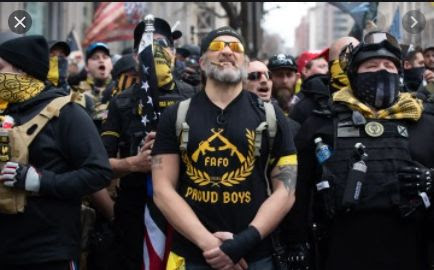
But at night, the scene became violent.  At least four people were stabbed near Harry’s Bar at 11th and F streets NW, a gathering point for the Proud Boys, a male-chauvinist organization with ties to white nationalism.

The victims were hospitalized and suffered possibly life-threatening injuries, D.C. fire spokesman Doug Buchanan said.  It was not immediately clear with which groups the attackers or the injured might have been affiliated.

The violence escalated after an evening of faceoffs with counterprotesters that took place near Harry’s, Black Lives Matter Plaza, Franklin Square, and other spots around downtown.

At first, officers in riot gear successfully kept the two sides apart, even as the groups splintered and roamed.  In helmets and bulletproof vests, Proud Boys marched through downtown in military-like rows, shouting “move out” and “1776!”  They became increasingly angry as they wove through streets and alleys, only to find police continuously blocking their course with lines of bikes.

“Both sides of the aisle hate you now.  Congratulations,” a Proud Boy shouted at the officers.

But before long, the agitators determined to find trouble were successful — and posturing quickly turned into punching, kicking and wrestling.

Again and again, officers swarmed, pulling the instigators apart, firing chemical irritants and forming lines between the sides.  At Harry’s Bar, an ambulance arrived, but the extent of injuries was unknown.

Each time a fight was de-escalated, another soon began in a different part of town.

. D.C. Police Chief Peter Newsham made a brief appearance in the chaos, telling protesters: “We’re doing the best we can.”

In an interview, Newsham said police units were deployed across downtown to keep the groups apart.  He said smaller segments of people who splintered from larger gatherings seemed “intent on conflict.”

D.C. police said that as of 9 p.m., 23 people were arrested Saturday, including 10 who were charged with misdemeanor assaults, six with assaulting police officers and four with rioting.  Police said one person had an illegal Taser.

Two officers were hospitalized with moderate injuries suffered during clashes at 16th and K streets NW, police said.  In all, police said eight people — including the four stabbing victims and the two officers — were injured.

The scuffles seemed poised to continue late into the night, as the black-and-yellow-clad Proud Boys knocked back beers, whiskey, and White Claws.  Some stole a Black Lives Matter banner, paraded it down M Street NW, then stomped on it.

The group received recognition from Trump himself at a Presidential debate in September, when he told them to “stand back and stand by.

As the Proud Boys appeared at rallies earlier in the day Saturday, Trump cheered on all of the supporters who showed up to falsely claim that the election was stolen from him, tweeting “Wow! Thousands of people forming in Washington (D.C.) for Stop the Steal.  Didn’t know about this, but I’ll be seeing them! #MAGA.”

The majority-White crowd ranged from gray-haired men and women in red hats to children in wagons, one of whom chanted “100 more years!”

As the nation watches Biden’s transition, rising coronavirus cases and vaccine development, Trump’s attempts to maintain power have also been playing out.  To his most dedicated supporters, the President’s megaphone is as loud as ever.  He has continued to falsely claim the election was stolen from him, prompting his faithful to return to the nation’s capital.

Flynn appeared on the steps of the Supreme Court to encourage them to maintain hope, despite the justices’ dismissal Friday night of Trump’s long-shot bid to overturn election results.

“Don’t get bent out of shape,” Flynn said.  “There are still avenues … We’re fighting with faith, and we’re fighting with courage.”

After Flynn finished speaking, he was chased by shouting admirers who cheered: “We love you, general!”  Bodyguards tried to keep the fans at bay as Flynn kept smiling.

The speakers painted a picture of a country in a battle between good and evil, in which God himself would ultimately ensure Trump remained in power.  Sebastian Gorka, a former foreign policy adviser to Trump, said that when he heard the Supreme Court had dismissed an election case from Texas on Friday night, he told himself to “stop, take a deep breath, count to 10, read the Bible and pray.”

“We, thanks to our lord and savior, have already won,” Gorka claimed.

A priest featured on a Jumbotron prayed to “place thyself at the head of this army of thy children.”

Ruth Hillary, 58, a pastor from California, listened while holding up her “Stop the Steal” sign.  She said she will continue to protest as long as the President and vice President believe she should.

“If President Trump accepts it and Vice President Pence accepts it, then we will accept it,” she said.  “But right now, this is a Godly protest.”

Jones, the Infowars host known for his denial of the Sandy Hook massacre, alternated between speaking about God and the future President: “Joe Biden is a globalist, and Joe Biden will be removed one way or another,” he said from a stage on the Mall.

Trump backer and MyPillow founder Mike Lindell argued that “Fox [News] was in on it,” while podcaster David Harris Jr. riled the crowd by suggesting that if there were a civil war, “we’re the ones with all the guns,” he said.

All day, the masses nodded along to falsehoods, prayed for the country and cheered beside one another without masks.

D.C. police did not enforce mask rules or issue fines to those who ignored social distancing guidelines, even as the region faces an unprecedented spike in coronavirus cases.  Dozens of D.C. police officers have tested positive in the weeks since the last pro-Trump rally in November.  As of Friday, 94 remained in quarantine.  Police have declined to draw a direct link between demonstrations and the spike in infections among officers.

On Saturday, local activists were frustrated with police tactics aimed at maintaining peace.  For part of the evening, officers formed intermittent blockades at the perimeter of Black Lives Matter Plaza, essentially penning in counterprotesters while Trump supporters were free to roam.

“They can move around however they please,” said Constance Young, 37.  “We’re not the ones not wearing masks and spreading COVID.”

D.C. residents have expressed concern that the influx of maskless protesters puts the entire city at risk, especially workers in restaurants and hotels.  Activists flooded the inboxes of city officials, asking them to shut down businesses that allow people to congregate without masks.  They called hotels to ask that they refuse to host those planning to attend Saturday’s rallies, with little success.

Protesters still came in from around the country, with family, friends and flags in tow.

David Dumiter, 33, and his niece Monica Stanciu drove eight hours from Dearborn, Mich., to be at the Washington Monument on Saturday.

Dumiter, an airplane mechanic who said he has been unemployed since the pandemic decimated air travel, said he knew the Supreme Court had blocked any legal path to reverse the results of the election.  That didn’t change his mind about showing up Saturday.  The President was still pushing, so he would, too.

“We’re not going to cave in,” Dumiter said.

That sentiment seemed to fuel the pro-Trump groups that stretched their demonstrations late into the night, even after every fight was broken up by police and multiple arrests were made.

At Harry’s, a half-dozen Proud Boys marched through the streets, chanting, “all lives matter!”  They were cheered on by other members of the group who joined them at 11th and E streets NW, flashing the three-fingered white-supremacist salute.

Moments later, the crowd turned and converged on a corner, shoving and jostling as the chant rose to a fever pitch.  Men pushed each other as they tried to film what was happening in the center of the chaos.

More than 100 D.C. police officers swarmed the street.  Police with canisters of chemical spray rushed into the fray, pushing people aside and separating the crowd.  Two people lying on the sidewalk were transferred into ambulances.

But an hour later, more than 150 demonstrators were still there, chanting and drinking in the rain.  The President was refusing to concede the election, and they were refusing to go home.

Joe Heim, Justin Wm.  Moyer, Meagan Flynn, Paul Schwartzman, Kyle Swenson, and Peter Hermann contributed to this report.

Monday, December 07, 2020

OPINION - Damage Done By Trump, Claims of Election Fraud

"Shields and Brooks on the damage done by Trump’s claims of election fraudPBS NewsHour 12/04/2020

Excerpt

SUMMARY:  Syndicated columnist Mark Shields and New York Times columnist David Brooks join Judy Woodruff to discuss the week in politics, including the Biden team’s transition to the White House and the impact of Trump’s election fraud claims.

Judy Woodruff (NewsHour):  And now it's time for the analysis of Shields and Brooks.  That is syndicated columnist Mark Shields, and New York Times columnist David Brooks.

Hello to both of you.

I want to pick up with what we were hearing, Mark, from Congressman Riggleman of Virginia, talking about putting party over country.  That was something he wasn't comfortable with, and talking about conspiracy theories, all of this stemming from President Trump insisting that he's won the election, that the election was completely riddled with fraud.

We're now hearing a number of Republicans calling for other Republicans to call the President out.  How much damage is being done by what is going on right now, Mark?

Mark Shields, syndicated columnist:  I can't calculate it, Judy, in concrete terms, other than to say it's dangerous.

I mean, America has been the envy of the world.  It's been an example to bring millions of people to our shores, a free and open democracy, where every voice is heard.  And to have the elected leader of that nation charge that it is not that, that it's corrupt, that it's criminal, is damaging beyond my calculation.

And I just — I think — I hope it's reparable, but we will — it will be a while before we find out just how much damage has been done.

Judy Woodruff:  David, how deep is the damage that's being done?

David Brooks, New York Times:  Well, 77 percent of Republicans or Trump backers say the election was stolen by fraud, according to a Monmouth poll.  A lot of those same people don't believe in manmade climate change.  A lot of those same people don't believe that masks can save your life.

So, there's a section of a country that's become detached from reality and, under Trump paranoia, has become a style, a resurgent style.

I wrote a column about this a week ago.  And I tried to theorize that this derives out of a sense of menace and threat, that people feel existentially unsafe, and so they grasp for conspiracy theories, because it makes them feel powerful, that they see the truth.  It makes them feel agency.  They can expose the evil cabals.

And I think there's some truth to that, that people — a lot of people just feel very scared economically, socially, racially.  And out of that fear comes paranoia.

But I got a lot of e-mails from people.  Like, I got one from a guy in Palo Alto.  And he said, the neurosurgeon down my block believes all this stuff.  So, where's his anxiety?  And I'd say, I don't know the answer to that question.

But there is a lot of anxiety.  There's a lot of fear, and out of that has arisen an entire industry of paranoia-mongering.  The Newsmax, the far right-wing media TV station, their viewership has gone up 20 times since the election.  So, that paranoia is pretty deep and pretty widespread right now.

Judy Woodruff:  Mark, we are — as a news organization, the "NewsHour" is trying to understand this.  I know other news organizations are as well.

We want to understand the origin of this and how deep it goes and how long-lasting.  How much does it matter that we try to tackle this right now?  Is it — I guess what I'm trying to understand, is this a flight of fancy, that we're just living through a brief period, and we're going to wake up in a few weeks or months, and we're going to be past it, or is this with us for a long time?

Mark Shields:  Well, no, I mean, I think David put his finger on it, as he does regularly.

This also has a commercial aspect to it.  I mean, there is a profit in upping your viewership if you're spinning paranoid theories to your listeners and explaining that the other side — you never argue on the merits, Judy.  What it comes down to is, the other side is evil.

I mean, that is the first thing I learned when I came to Washington, that you don't question the motives of somebody on the other side, that they love their country and their children as much as you do.  And they may be mistaken, they may be ill-informed, they may be illogical, but you don't start off with, they're evil.

Well, that is — that's where these arguments begin, that it's a sinister, criminal collusion all out to get the American way, to destroy the American way.  It is anything we can do to rebut it.

And one hopes that the new administration, with a fresh start, will be a start in that direction.  And the fact that the President — that his predecessor is now receding in the rearview mirror, inevitably, I think, has to be helpful.

Judy Woodruff:  And, David, I guess my question is, is his predecessor disappearing in the rearview mirror?  He's raised over $200 million and counting since the Election Day for his legal defense fund.

But we are now learning that money, most of that money can go toward his new political venture, whatever it may be.  President Trump may be here for a long time to come.

David Brooks:  He's certainly talking like he will run again in 2024.

And Josh Hawley, the senator from Missouri, said that, if Trump runs again, he would endorse him and expect him to win.  And he might.  He might win the nomination again.  So, I don't think we have seen — maybe not seen the last of him.

The problem with all the paranoia and the conspiracy theory is, you can't talk people out of it.  The psychological research is super clear on this, that if you try to fact-check people when they have incorrect facts, you only entrench their belief, that you can't talk people out of an emotional state.

And so I think the two things that we can do is try to have contact, more contact between, frankly, those of us in the expert class, who tend to live in blue America, in the metro areas, and people in the rural country.

COVID doesn't allow that.  But traveling around the country is a good way to alleviate a lot of the barriers between us.  And, second, somehow, life has to become more secure for a lot of people.  And I'm hoping the administration, the new administration, will pass legislation that makes life economically more secure, so that sense of existential anxiety goes away.

Judy Woodruff:  Well, we can certainly hope not only the economy gets better, that we will all be able to travel more, get around, see our fellow Americans, family and friends in the not-too-distant future.

But, Mark, let's talk about Joe Biden, the President-elect.  Since the last time I saw the two of you, two weeks ago, before Thanksgiving, he's named more of the senior members of his team, his Secretary of State Tony Blinken, his Secretary of the Treasury Janet Yellen, a number of others.

What do you make of the team so far?

Mark Shields:  Well, I would say, the reviews, Judy, that are in are quite positive.

I mean, they reflect Joe Biden.  They're experienced.  They believe in public service.  They're people whom he knows, again, unlike his unnamed predecessor, who chose a Secretary of State because he had a very active passport and had traveled a lot and looked like a secretary of state.  He's choosing somebody with whom he's worked for close to a generation, experienced people, people who believe in public service.

And I guess dully competent would be the unflattering observation.  But I'm impressed.  And you mentioned a Janet Yellen.  I think that is a 10 strike.  I mean, to have the chairman of the — former chairman of the Fed, former chairman of the Council of Economic Advisers of her stature and, figuratively speaking, and just her values as Secretary of the Treasury, I think is just awfully important, especially with Joe Biden, who has great experience in foreign policy and — but not deep in financial matters.

So, I'm encouraged by them.

Judy Woodruff:  David, what's your take on these folks Joe Biden is naming?

David Brooks:  Yes, I'm super encouraged too.

It's Biden being Biden.  It's Biden people — picking people he's comfortable with, people he knows, and people who you could wake up in the middle of night, and they could do the job.  Janet Yellen is super well-prepared to be Treasury Secretary, Jake Sullivan, a rising young star in the policy world.  Jared Bernstein has been on this program many times in the economic world.

Neera Tanden will be our flashiest OMB Director in history, but someone who's been around and who just knows the job.  And so you can rest assured that these are people who have experience and often served in the job right below them in the Obama administration.  So, we can expect fewer own goals under them.

Judy Woodruff:  Well, we're seeing, Mark, a number of women put into — or nominated for prominent roles, powerful roles in the new administration.

But there's still some interest groups out there saying there's not enough diversity here, for example, NAACP saying, where are the blacks in senior Cabinet jobs?

How much pressure is Joe Biden under to name a more diverse — more diverse leaders in — to his team — for his team?

Mark Shields:  Well, I mean, the diversity so far, Judy, I mean, I don't think anybody can make the case that it's for diversity's sake.  Everybody who's been chosen is somebody who qualified and is qualified for the position to which they were named, irrespective of race or gender or whatever.

I think that, as far as women is concerned, I mean, Joe Biden's campaign was run by Anita Dunn and Jen O'Malley Dillon, two women.  I mean, he's used to having women.  His sister Valerie ran all his other early campaigns for the Senate.  So, that is — that's a natural.  That's not window dressing.  That's a very natural development.

I think that the most important voice to Joe Biden has to be that of Congressman Jim ClyburnAnd Jim Clyburn has been critical of the paucity of African Americans in the Cabinet.

Joe Biden came crawling out of Iowa, limping out of New Hampshire.  He was dead on arrival in South Carolina, until African American voters, led by — led by Jim Clyburn, endorsed him and made him the nominee.  So, if he's going to heed any voice, the voice of Jim Clyburn is the voice that Joe Biden will be responsive to, and legitimately so.

Judy Woodruff:  And, David, how much pressure do you think Biden is under to name — get some more diverse figures in this Cabinet in top jobs?  And how much does it matter?

David Brooks:  Well, pressure implies resistance.  I don't think there's any resistance.

I think Joe Biden wants to have a diverse Cabinet.  He wants to have a Cabinet that looks like America, in part because it's a better Cabinet idea.  You have — the bigger diversity of viewpoints and backgrounds, the better decisions that get made.

And I don't think he will have any problem finding African Americans.  He's already found Linda Thomas-Greenfield, who's the — his choice for the U.N. Secretary — our Ambassador to the U.N.  And she's someone who has a long time career in the Foreign Service, somebody who ran the Africa desk under Obama.  I'm sure he will find many more people under that.

I think it's important to have vast diversity.  I hate to — when it gets reduced to a demographic label and a person is filling in a slot.  The person is the person.  And all the people he's picked so far and in the future are A-team.  They're super talented.

And so I'd hate to see it get down — it appear, even appear like it's just because of somebody's skin color or anything, because I don't think it ever is going to be that.

Judy Woodruff:  Well, he's saying he's got more to name.  He said you will know who they are in the next few weeks, and he said you can judge it then.

So, we will keep talking about it, keep looking at it.

Mark Shields:  Yes.

Judy Woodruff:  Thank you both, David Brooks, Mark Shields.  Thank you.

Mark Shields: Thanks, Judy.


AMERICAN POLITICS - Georgia vs Trump Election Fraud Claims

"Why this Georgia election official called out Trump’s fraud claimsPBS NewsHour 12/02/2020

COMMENT:  Simple answer, Trump is a lier and throwing a tantrum like a 5 year old.

Excerpt

SUMMARY:  A top Georgia election official on Tuesday had sharp words for President Trump and some Republicans, as the president continues to cast doubts on Georgia's election results with disproven claims of widespread fraud.  Gabriel Sterling, who works with the Georgia secretary of state’s office, joins Judy Woodruff to discuss his comments.


Tuesday, November 24, 2020

AMERICAN POLITICS - Biden Transition Offically Starts

"Transition process formally under way.  GSA action allows briefings, funding for Biden team." by U-T News Services, San Diego Union-Tribune 11/21/2020

NOTE:  This is copied from the e-newspaper, therefore no link to article.

President Donald Trump’s government on Monday authorized president-elect Joe Biden to begin a formal transition process after Michigan certified Biden as its winner, a strong sign that the President’s last-ditch bid to overturn the results of the election was coming to an end.

Trump did not concede, and vowed to persist with efforts to change the vote.  But the President said on Twitter on Monday night that he accepted the decision by Emily Murphy, the administrator of the General Services Administration [GSA], to allow a transition to proceed.

In his tweet, Trump said that he had told his officials to begin “initial protocols” involving the handoff to Biden “in the best interest of our country.”

Murphy’s designation of Biden as the apparent victor provides the incoming administration with federal funds and resources and clears the way for the president-elect’s advisers to coordinate with Trump administration officials.

The decision from Murphy came after several additional senior Republican lawmakers, as well as leading figures from business and world affairs, denounced the delay in allowing the peaceful transfer of power to begin, a holdup that Biden and his top aides said was threatening national security and the ability of the incoming administration to effectively plan for combating the coronavirus pandemic.

And it followed a key court decision in Pennsylvania, where the state’s Supreme Court on Monday ruled against the Trump campaign and the President’s Republican allies, stating that roughly 8,000 ballots with signature or date irregularities must be counted.

In Michigan, the statewide canvassing board, with two Republicans and two Democrats, voted, 3-0, to approve the results, with one Republican abstaining.  It officially delivered to Biden a key battleground that Trump had wrested away from Democrats four years ago, and rebuffed the President’s legal and political efforts to overturn the results.

By Monday evening, as Biden moved ahead with plans to fill out his Cabinet, broad sectors of the nation had delivered a blunt message to the President: His campaign to stay in the White House was nearing the end.

Murphy said she made her decision Monday because of “recent developments involving legal challenges and certifications of election results,” most likely referring to the certification of votes by election officials in Michigan and a nearly unbroken string of court decisions that have rejected Trump’s challenges in several states.

In conversations earlier in the day with top aides — including Mark Meadows, the White House Chief of Staff; Pat Cipollone, the White House Counsel; and Jay Sekulow, the President’s personal lawyer — Trump was told that the transition needed to begin.  He did not need to say the word “concede,” they told him, according to multiple people briefed on the discussions.  But they emphasized that in the United States, transitions are hugely important.

Some of the advisers drafted a statement for the President to issue.  But Trump continued to solicit opinions from associates, including Rudy Giuliani, who told him there were still legal avenues to pursue, the people briefed on the discussions said.

In the end, Trump did not put out a statement, but aides said the tone of the proposed statement was similar to his tweets in the evening, in which he appeared to take credit for Murphy’s decision to allow the transition to a new administration to begin.

“Our case STRONGLY continues, we will keep up the good fight, and I believe we will prevail!” he wrote.  “Nevertheless, in the best interest of our Country, I am recommending that Emily and her team do what needs to be done with regard to initial protocols, and have told my team to do the same.”

In a letter to Biden, Murphy rebutted Trump’s assertion that he had directed her to make the decision, saying that “I came to my decision independently, based on the law and available facts.” She said she was “never directly or indirectly pressured by any executive branch official — including those who work at the White House or the GSA.”

“I do not think that an agency charged with improving federal procurement and property management should place itself above the constitutionally-based election process,” she wrote, defending her delay by saying that she did not want to get ahead of the constitutional process of counting votes and picking a President.

Murphy said she had received threats online, by phone, and by mail “directed at my safety, my family, my staff, and even my pets in an effort to coerce me into making this determination prematurely.”

“Even in the face of thousands of threats, I always remained committed to upholding the law,” the letter said.

She did not describe Biden as the “president-elect” in her letter, even as she said the transition could begin.

One associate with knowledge of Murphy’s thinking said that she always anticipated signing off on the transition but that she needed a defensible rationale to do so in the absence of a concession from Trump; the pro-Biden developments in Michigan and Pennsylvania, as well as in Georgia, provided a clear justification for moving ahead.

That decision was part of a cascade of events over the last several days that appeared to signal the end of Trump’s attempts to resist the will of the voters.

Large counties in Pennsylvania were formalizing Biden’s victory in the state.  And in a major break with the President, General Motors announced it would no longer back the administration’s efforts to nullify California’s fuel economy rules.

On Capitol Hill, most of Trump’s Republican allies had stood by his side for the past two weeks as he [Trump] tried to overturn the vote.  But on Monday, some of the Senate’s most senior Republicans sharply urged Murphy to allow the transition to proceed.

Sen. Lamar Alexander of Tennessee, who is retiring, issued his second call in recent days for a prompt transition.

“Since it seems apparent that Joe Biden will be the president-elect, my hope is that President Trump will take pride in his considerable accomplishments, put the country first and have a prompt and orderly transition to help the new administration succeed,” said Alexander, a close friend of Sen. Mitch McConnell (R-Ky) the Senate majority leader.  “When you are in public life, people remember the last thing you do.”

Earlier in the day, Sens. Rob Portman of Ohio and Shelley Moore Capito of West Virginia, both Republicans, issued statements breaking from Trump and calling for Biden to begin receiving coronavirus and national security briefings.

“At some point, the 2020 election must end,” Capito said.

The pressure on Trump extended beyond the political sphere.  More than 100 business leaders sent a letter to the administration on Monday asking it to facilitate a transition, and a group of Republican national security experts implored Republican members of Congress to demand that Trump concede.

One of the President’s staunchest supporters, Stephen Schwarzman, the chief executive of the private equity firm Blackstone, did not sign the business leaders’ letter but said in a statement that “the outcome is very certain today and the country should move on.”

The New York Times and The Washington Post contributed to this report.


Monday, November 09, 2020

VOTE 2020 - Rundown Sunday 11/08/2020

"Vice President-elect Harris’ win brings many historic firstsPBS NewsHour 11/08/2020

Excerpt

SUMMARY:  Kamala Harris gave her victory speech wearing all white on Saturday night after her glass ceiling-shattering win as Vice President-elect.  Barbara Perry, Director of Presidential Studies and co-chair of the Presidential Oral History Program at the University of Virginia's Miller Center, joins Hari Sreenivasan to discuss the historic nature of Harris’ election and the road it took to get here.


"Dems won the race but the GOP will control the presidencyPBS NewsHour 11/08/2020

Excerpt

SUMMARY:  While Joe Biden and Kamala Harris are headed to the White House, Democrats who were hoping to increase their margins in the House and take control of the Senate, failed to strengthen their position in Congress.  Jeff Greenfield joins to discuss the election results and how the Senate runoff in Georgia will determine the future of Biden’s presidency.


VOTE 2020 - Rundown Saturday 11/07/2020


"Lack of evidence make Trump’s legal challenge an uphill battlePBS NewsHour 11/07/2020

Excerpt

SUMMARY:  President Trump has vowed to challenge the election results, which have declared Joe Biden as the President-Elect.  The legal challenges began well before Election Day with lawsuits over mail-in voting and which ballots were “legally” cast.  Guy-Uriel Charles, professor of law at Duke University and co-director of the Center of Law, Race and Politics joins to discuss.


"Biden will take over a deeply divided nation in crisisPBS NewsHour 11/07/2020

Excerpt

SUMMARY:  With news outlets from the Associated Press to Fox News calling the election in favor of Joe Biden on Saturday, President Trump’s camp continued their legal efforts to contest the election results, and many Republican leaders remained silent.  Yamiche Alcindor joins Hari Sreenivasan to discuss Trump’s strategy, as well as Kamala Harris’ historic win as the first woman of color to be elected Vice President.


"Georgia to be ‘center of the American political universe’ during recount, runoff electionPBS NewsHour 11/07/2020

Excerpt

SUMMARY:  Nearly 5 million ballots were cast in Georgia, where razor-thin margins in the presidential election mean the state will enter a recount process in the coming weeks, and a January runoff will decide the fate of both the state’s Senate seats.  Georgia Public Broadcasting’s Rickey Bevington joins Hari Sreenivasan to discuss why, between now and January’s runoff election, all eyes will be on Georgia.


"‘More lawsuits are coming:’ Trump’s lawyers layout plans as AP calls race for BidenPBS NewsHour 11/07/2020

Excerpt

SUMMARY:  Shortly after the Associated Press and other TV networks call Pennsylvania and the entire race for Joe Biden, President Trump’s lawyers lay out their plans for a long legal fight over the results.  NewsHour’s Dan Bush joins from Philadelphia to discuss the moment Biden’s victory was called and the Trump campaign's plan of action.


OPINION - Shields and Brooks on Vote 2020

"Shields and Brooks on election results, national divisionsPBS NewsHour 11/06/2020

Excerpt

SUMMARY:  Syndicated columnist Mark Shields and New York Times columnist David Brooks join Judy Woodruff to discuss the week in politics, including surprises from a very close presidential election whose result is still unknown, which groups of voters increased their support for President Trump, political challenges for the Democratic Party and what national divisions say about the future of the country.

Judy Woodruff (NewsHour):  And now to the analysis of Shields and Brooks.  That is syndicated columnist Mark Shields and New York Times columnist David Brooks.

So, hello to both of you.

We don't have a result yet, but the votes are being counted like mad.  We know the results in a lot of states.

We're waiting.

David, what do you make of what we know so far?

David Brooks, New York Times:  Well, if ever there was a campaign that was going to be a blowout, I thought this was it.  I thought we had an unpopular President that people were ready to get rid of.  I expected a large margin.  And I was wrong.  It's a 2.8 percentage margin nationally.

And so I think what we have learned is that we a very evenly divided nation, two groups of people in non-overlapping universes.  For a time, it seemed — and I think people in both camps thought, well, the people on my team could eventually crush the people on the other team, and my team will get to rule.

I think we now have to face reality.  That's just never going to happen.  The other side is never going to go away.  And we have got to find a way to live with each other.

And so, to me, that's the biggest takeaway of where we are right now.

Judy Woodruff:  Mark, divided country.

Mark Shields, syndicated columnist:  Divided country, Judy.

But if you look at it in historical perspective, in the last century, only three presidential challengers, nominees have defeated an elected President seeking reelection.  And it's a pretty impressive group, if you think about it.  It was Franklin Roosevelt, it was Ronald Reagan, and it was Bill Clinton, all of whom were at least two-term presidents.  One was a four-term president, and I think history would say successful Presidents.

So, Joe Biden joins a pretty awesome group of people.  He will end up, in my judgment, with a 52-47 popular vote percentage, decisively, and decisively in the Electoral College.

David's right.  It was close.  We are divided.

What surprised me, as much as anything, was the loyalty and the enthusiasm of Donald Trump's constituency.  They turned out in surprisingly impressive numbers.  And Donald Trump, if he got over his hissy fits and sort of the silly actions since the election, could take credit for the Republicans picking up House seats in 2020 and retaining their majority in the Senate.

With the exception of Susan Collins, every other Republican Senate candidate who won, won with Donald Trump.  Susan Collins had a 17-point split in Maine.  That was the only ticket-splitting state in the country.

Judy Woodruff:  So, David, I know you have also — you have had a chance to look inside some of these numbers, why voters voted, who voted how, and why people voted the way they did.

I mean, even as we're waiting for the final numbers, what does that tell you about the country, about who we are?

David Brooks:  Well, I mean, the surprises were the gains that Republicans made among Latinos and African-Americans.  Donald Trump had a higher share of the non-white vote than any Republican in 60 years, as he said.

And that was a surprise to me.  He doubled his support among the LGBTQ community.  And so a lot of people are voting by different narratives.  There is a certain narrative that he's a racist and that he's just a force for racism.  I think there's a lot of truth to that narrative, but a lot of people clearly have different narratives in their head.

And so I think people — we should be humble about generalizing across groups of people, especially people we have never met.  And so I think that.

The second thing is that the Republican Party really is the party of the — of people without college degrees, much more so than ever before.  We saw swings of moderates, swings of college-educated suburbanites to the Democratic Party.

And I think the Republican Party can — if they're going to be — feel good about this election, they can see the potential of a future party as a multiracial working-class party.  If they can win support across racial lines among those without college degrees, then that's a very viable party, and they should really focus all their attention on, what can we do for people without college degrees of all groups?

Judy Woodruff:  What about that, Mark?

And, as you look at how people voted, which way they went, what do you see?  What does it tell you about us?

Mark Shields:  Picking up on what David said, you can't make generalizations about people you do know, David.  You have to make generalizations about people you don't know.

(LAUGHTER)

But the point is that David touched on it on the white blue-collar male vote, one out of three voters in the country.

This was the backbone of the Democratic coalition that elected Franklin Roosevelt and Harry Truman, and Jack Kennedy.  It was the message of the entire New Deal, Fair Deal, and New Frontier, that government had a responsibility to guarantee jobs, that you weren't the nation of self-reliance and independence completely, especially in the face of a Great Depression.

But the important thing to remember is that the 346 firefighters who walked into the jaws of death and the fires of hell on September 11 to save strangers that never met and gave their lives so doing were white non-college males, for the most part.

Those who volunteer to defend our country, whether it's joining the Marine Corps or the armed forces, and fight and die, it's their families, and they're the families of white, overwhelmingly white, not-college-educated males.

And the Democrats' problem, I think, is one of attitude as much as it is of platform.  I mean, the Democrats, that were once a shot and a beer party have become a Sauvignon blanc party arguing about which wine is more sensitive.

And I really — I really do think this is a problem for Democrats.  And they have to — they have to approach with some humility this very important constituency, which Donald Trump beat them almost 2-1 and beat Joe Biden, I mean, who is really probably the personification of what the New Deal was, in terms of personal style, personal values, and personality.

So, he wasn't beating an elitist Ivy Leaguer.  So I think that's a real problem for Democrats.  And I would add the Hispanics.  I think we have learned painfully, did Democrats, that they're there anything but a monolithic constituency, as most proved by the results in Florida.

Judy Woodruff:  I want to turn you, David, to the president's reaction so far to the results of the lashing out, the accusations of fraud and the rest of it.

How much does all that matter?  I mean, does the delay in announcing — in knowing the result, how much will that matter in the end?

David Brooks:  Yes, well, I thought the President in his press conference last night was awful, horrific, if we weren't used to him, but also wan.  He looked like he was not really fighting; he was just constructing rationalizations for a man who can admit that he can lose at anything.

And I think I have been heartened, I mean, as we heard from William and others, that there is a lot of crazy stuff going around on the Internet, a lot of conspiracy theories, as if the Democrats have this elaborate vote-rigging thing in which they lose the Senate.  Like, it doesn't pass even surface plausibility.

But what has heartened me is that, so far, our system seems to be holding better than many people feared.  A lot of Republicans are happy to see Trump go and are ushering statements or just non-statements and not getting on this train.

And state legislators in places like Pennsylvania have said, we're not getting involved in this.  And the nightmare scenario was that you would get competing slates of electors from places like Pennsylvania.  But that would require the complicity of a lot of the politicians in these states.

Judy Woodruff:  Yes.

David Brooks:  And, so far, they don't want to get involved.

So, that's — I think the system is doing way better than we could have feared.

Judy Woodruff:  You do have Lindsey Graham out there echoing what the President is saying.

David Brooks:  Oh, yes, for sure, there are some.  And FOX is divided.  The all-important FOX News seems to be divided.

But, so far, we have not seen violence that much in the streets.  So far, it looks like calmer than many predicted.

Judy Woodruff:  Mark, what's your — what is your take on the President and how he is reacting so far and what it says?

(CROSSTALK)

Mark Shields:  David, he's younger and more optimistic.

I have to say, I haven't found that many good Germans among the Republicans who are resisting the — just think, Judy.  The President, before the largest audience in the history of humankind, according to him, took an oath to solidly preserve, protect and defend the Constitution of the United States.

I just wish he would reflect on that for 30 seconds.  What he is doing is undermining confidence and trust in our — in each other, in our country, in our ways.

I have been incredibly impressed by the quality of the secretaries of state who have come on, almost overwhelmingly women, Republicans and Democrats, who have explained what they're doing, have done it in a thoughtful and informed and intelligent way.  I have been impressed by the seriousness of purpose that the people have taken in counting.

But I'm waiting for the Republicans.  I'm waiting for Rob Portman of Ohio, who everybody says is such a good guy.  I'm waiting for him to stand up and say, no, Mr.  President, this is wrong.

And we're hearing from the usual suspects.  Lindsey Graham makes Tonto look like an independent spirit when it comes to President Trump.

Judy Woodruff:  And, David, here at the end, I mean, you're not worried about the fact that — I mean, we don't know how long it's going to take.  I mean, there may be a call tonight, for all we know, but it is taking days.

Do you have concern that leaves — casts a pall over this somehow?

David Brooks:  Well, for sure.

I mean, there will be a large number of Americans who — if Biden wins, who think Joe Biden is an illegitimate President.  We're not — we shouldn't pretend that we're ending an age of polarization.

I'm just hopeful.  We're having a different sort of polarization.

Donald Trump was a cultural figure.  He was not a policy person, not a government person.  It was always: My tribe is good.  Your tribe is evil.

And so we have had that kind of polarization.  I'm hopeful, if Donald Trump is off the scene, at least there won't be a guy at the top waging a holy war against another identity group every single day.

And so I'm sticking with my blind and completely unrealistic optimism, no matter what's Mark says.

Judy Woodruff:  All right, we're going to let you do that, David Brooks.  And we're all going to wait and see what happens.

David Brooks, Mark Shields, thank you.


VOTE 2020 - Rundown Friday 11/06/2020

"Biden campaign remains confident as Trump escalates false claimsPBS NewsHour 11/06/2020

Excerpt

SUMMARY:  Former Vice President Joe Biden is leading President Trump in three of the five states yet to be called by the Associated Press.  Still, it’s not clear when vote counting will conclude.  Meanwhile, Trump lashed out at the voting process in a Thursday news briefing, and his campaign is filing lawsuits to challenge results.  Yamiche Alcindor reports and joins John Yang and Judy Woodruff to discuss.


"When election disinformation is a domestic threatPBS NewsHour 11/06/2020

Excerpt

SUMMARY:  The week has seen a flood of disinformation about the election -- much of it coming from President Trump and his allies.  In addition to false claims about voter fraud, there have been allegations that polling firms conspired to discourage Trump supporters from voting, and social media misinformation remains difficult to control.  William Brangham joins Judy Woodruff to discuss facts vs. falsehoods.


"The data behind some surprising election resultsPBS NewsHour 11/06/2020

Excerpt

SUMMARY:  What trends and shifts accounted for unexpected election results this week?  Amna Nawaz and Lisa Desjardins take a look at data from Pennsylvania, Georgia, Iowa, and more states critical to the outcomes of the presidential race and the balance of power in the House and Senate.